
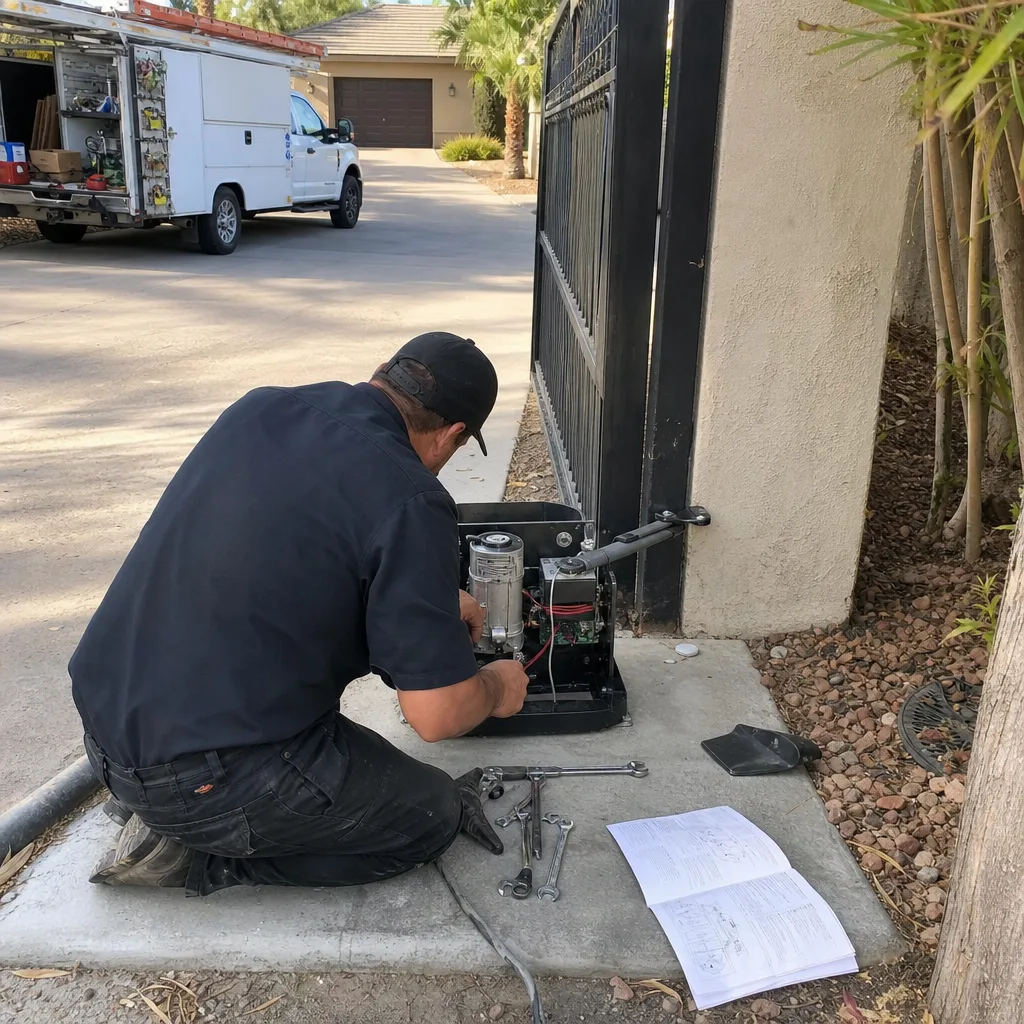
Last updated November 18, 2026
 Wrought iron
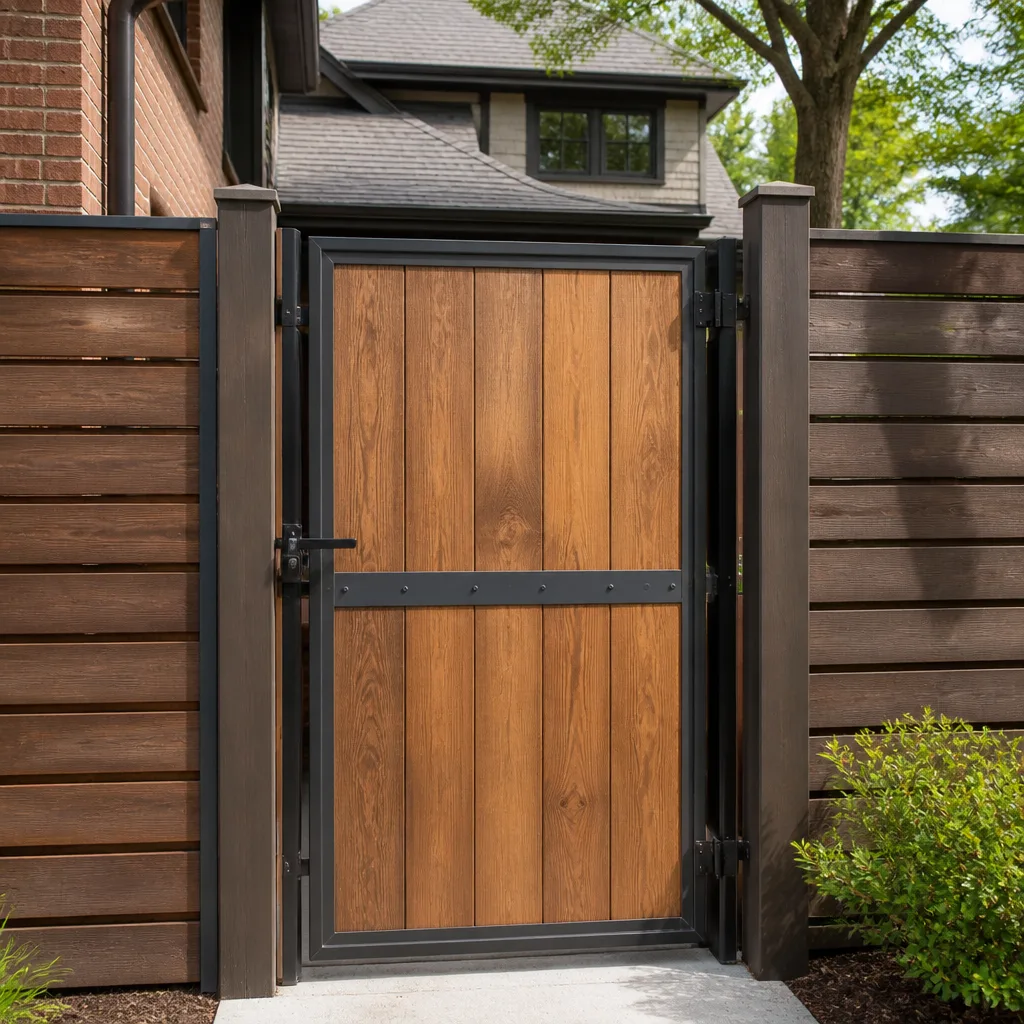 Wood & steel frame
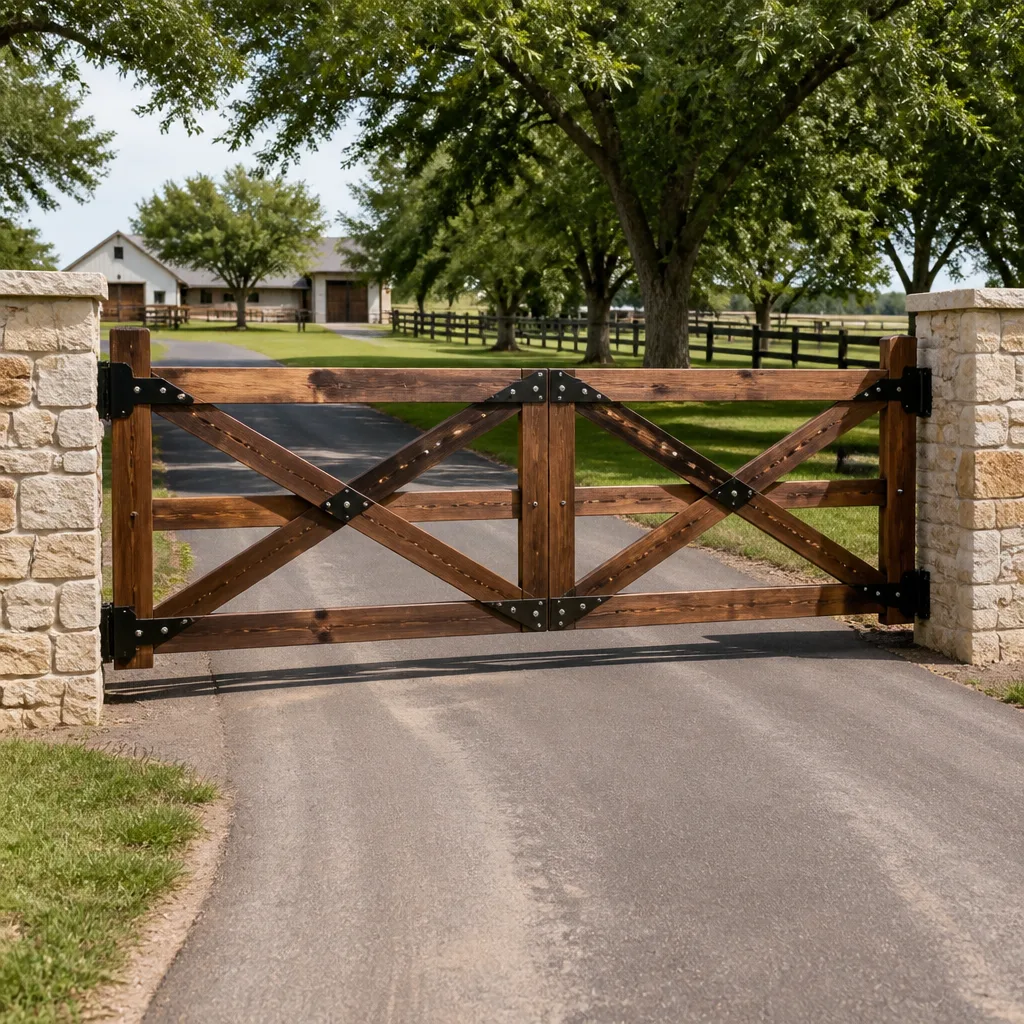 Farm & ranch
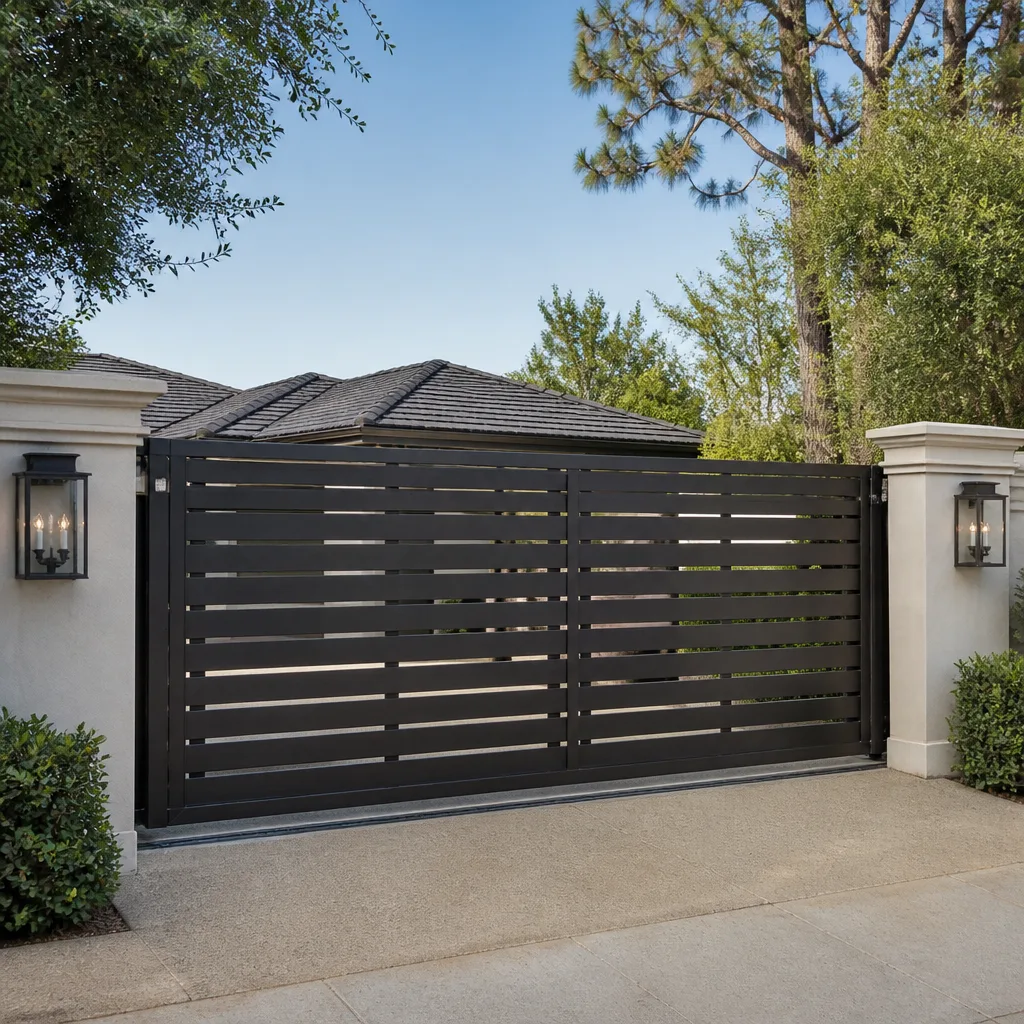 Sliding driveway gates
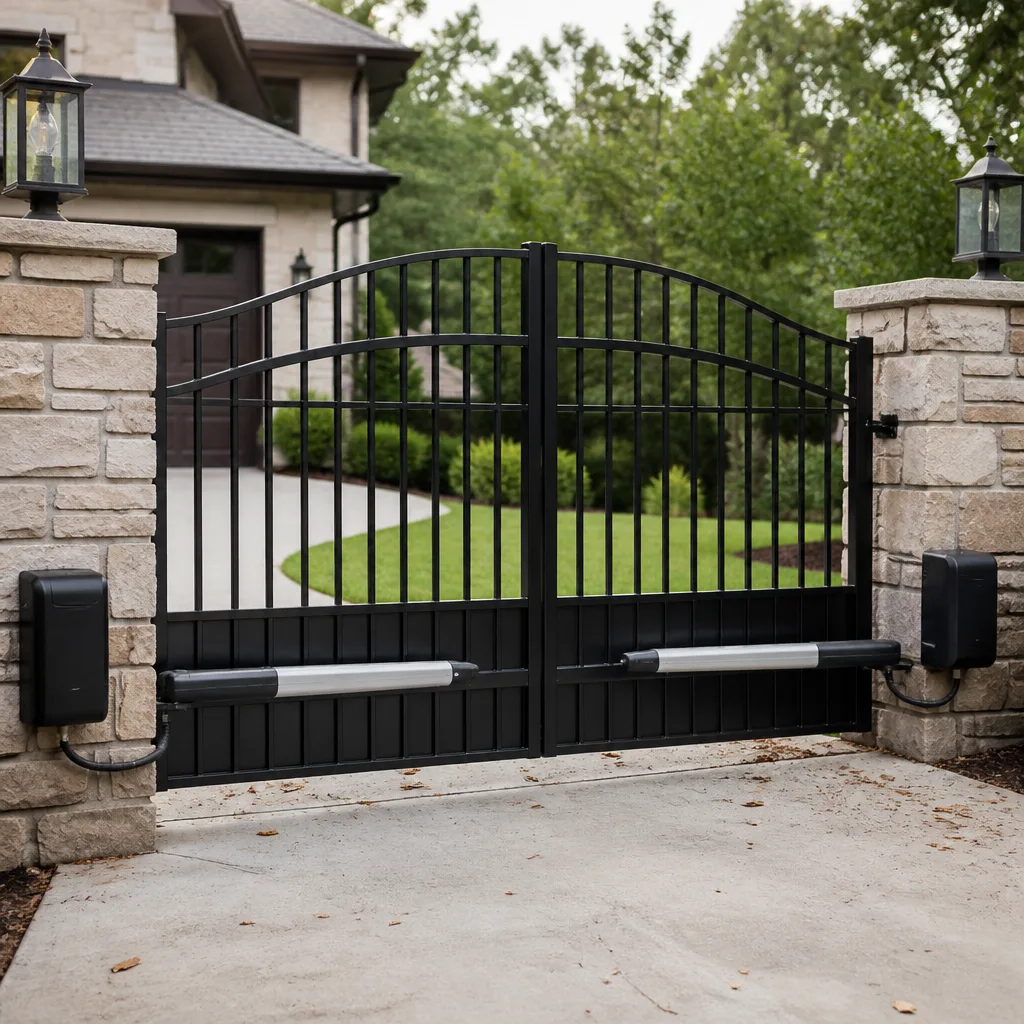 LiftMaster operators
Free on-site gate assessment - hinges, posts, and your LiftMaster or Nice gate operator checked before anything is quoted
The assessment is free and the quote is the invoice.
Get your free estimateGate Repair Maintenance Checklist for Paradise Homeowners
Hard water from the Las Vegas Valley Water District leaves calcium deposits inside gate operator gear housings that standard lubrication schedules never address. In our experience, that single overlooked problem is one of the top three reasons automatic gates fail early in the Paradise area. You can’t fix it with a squirt of WD-40 twice a year, and you can’t copy a checklist written for a place with four mild seasons and no alkaline dust. This guide walks through what actually fails on a Paradise gate, month by month, so you can catch it before it costs you a motor.
Quick Answer
A working maintenance checklist for a Paradise, NV gate covers hinge-post tightening, joint lubrication with high-temp grease, hard-water flushing of the operator housing and weep holes, and a two-minute visual pass every month. Most gate failures in Paradise start with mineral buildup or loosened hinge posts, not with the motor itself. Do the small checks monthly and the deep clean before monsoon season in July, and you’ll get years more out of the gate than neighbors who wait for something to break.
Styles & brands we work with
- Wrought iron
- Wood & steel frame
- Farm & ranch
- Sliding driveway gates
- LiftMaster operators
Table of Contents
- Why a Paradise Gate Needs Its Own Checklist
- The Two-Minute Visual Inspection That Catches 80% of Problems
- The Month-by-Month Paradise Gate Calendar
- Lubricants That Hold Up Above 110°F (And the Ones That Turn to Varnish)
- Clearing Weep Holes and Drain Channels Before Monsoon Season
- What to Photograph Each Inspection So a Tech Can See the History
- Motor and Opener Checks Most Checklists Skip
- Common Mistakes to Avoid
- When to Call a Professional
Why a Paradise Gate Needs Its Own Checklist
A gate in Paradise lives in a climate that most maintenance advice simply doesn’t account for. Summer afternoons regularly push past 115°F. The dust blown in from the desert is alkaline, which means it doesn’t just sit on metal – it quietly eats at it. And the water isn’t soft. The Las Vegas Valley Water District delivers water heavy with calcium, and every time a sprinkler overspray hits the gate or the operator housing catches splash-back, it leaves mineral film that dries into a crust.
That crust is the quiet killer. Calcium gets into hinge knuckles, into the gear housing on an operator, into the channel of a sliding gate, and it acts like sandpaper every time the gate moves. A homeowner in a mild coastal town can get away with spraying hinges twice a year and calling it maintenance. A homeowner in Paradise who does the same thing is skipping the part that actually matters.
We’ve pulled operators apart in Paradise that were less than six years old and looked twenty. The motor was fine. The gears were packed with dried mineral grit. That’s the pattern here, and it’s why a generic four-season checklist is worse than nothing. It makes you think you’re covered.
If you’re weighing repair versus replacement right now, Gate Repair in Paradise covers what we typically find on a first visit.
The Two-Minute Visual Inspection That Catches 80% of Problems
Before we get into the calendar, here’s the check you should do every month. It takes two minutes, needs no tools, and catches most problems while they’re still cheap.
- Watch the gate open and close on its own. A gate that drifts, hesitates, or shudders is telling you something. Note exactly where it does it.
- Look at the hinge posts, not the middle of the gate. A sag shows up at the post. If the post wobbles when you push the gate, the problem is at the anchor, not the panel.
- Open the gate by hand. If it drags or binds, the hinges or the track need attention before the motor forces through it.
- Shine a light on the operator housing. Look for white chalky streaks or crusty rings around seals – that’s hard-water mineral buildup.
- Scan the ground under the gate. Any pile of metal shavings, rust flakes, or fresh cracks in the concrete suggests movement you can’t see from above.
If any of those five checks shows a problem, snap a photo and write the date on it. Which brings us to documentation, later in this guide. In Paradise, most expensive gate failures announce themselves through one of these five checks weeks before they actually break.
The Month-by-Month Paradise Gate Calendar
Paradise doesn’t really have four seasons. It has a hot season, a monsoon edge, a brief cool stretch, and a windy spring. This calendar is built around those, not around a June-through-August summer template.
January through February – Cool-Season Deep Clean
- Wash the gate frame and operator housing with a garden hose and a soft brush to strip mineral film before it sets.
- Check and tighten every hinge bolt and post anchor (hand tools only – don’t over-torque).
- Test the manual release on the operator. If it sticks, that’s your first clue the grease is failing.
March through April – Wind and Dust Check
- Wipe down and re-grease all hinge knuckles and the track rollers with high-temp grease.
- Blow dust out of the operator housing vents. Alkaline dust in Paradise clogs faster than homeowners expect.
- Inspect the driveway channel and clear out any grit that has collected over winter.
May through June – Pre-Monsoon Prep
- Flush weep holes and drain channels (see the section on this below).
- Inspect all seals and gaskets on the operator housing – a hardened seal lets water in during the first real rain.
- Photograph the full gate and operator from four angles for your records.
July through September – Monsoon Watch
- After every storm, do the two-minute visual check again.
- Re-check drainage around the gate footing – pooled water is what kills post anchors.
- Look for rust bloom on any bare metal where paint chipped in the heat.
October through December – Cool-Season Tune-Up
- Re-grease everything that moves, including the operator chain or screw drive.
- Test the safety sensors and any reverse-on-contact feature.
- Touch up paint on rust spots before the next summer.
Lubricants That Hold Up Above 110°F (And the Ones That Turn to Varnish)
This is the part where most homeowner checklists go wrong. They say “lubricate hinges” and stop there. In Paradise, using the wrong lubricant is worse than using none, because the wrong one bakes into a varnish that gums up the hinge knuckle and binds the whole gate.
What works in this climate: a high-temperature lithium-complex grease rated for at least 300°F drop point, or a synthetic PTFE-based grease for the operator gears. Both hold their film under 115°F summer heat and don’t dry out in a single season. For chains and slide tracks, a dry-film PTFE spray handles the dust better than a wet oil because it doesn’t collect grit.
What doesn’t work: WD-40 as a lubricant (it’s a solvent, and it burns off in a matter of weeks under Paradise sun), general-purpose household oil, and any grease not labeled for high-temperature use. We’ve opened operators in Paradise where the original factory grease had turned into a brittle amber crust that crumbled into the gears. That’s what happens when summer after summer of heat cycles cooking the wrong lubricant. A BFT or Viking operator treated this way will chew through its gearbox inside a decade.
Apply lubricant sparingly. A hinge knuckle needs a thin film, not a glob. Excess grease catches desert dust, and in Paradise that dust is the thing you’re trying to keep out of the joint in the first place. If you’re not sure which grease is in your rig, call us and we’ll tell you what’s correct for your operator model.
Clearing Weep Holes and Drain Channels Before Monsoon Season
Every gate operator housing and many gate-post bases are built with weep holes – small channels designed to let any trapped moisture drain out. They exist because condensation and rain get in no matter what, and the housing needs a way to let it back out. In a place like Paradise, where the first real storm of the year hits after nine months of dust accumulation, those weep holes silently clog. Then the monsoon arrives, water fills the housing, and the motor sits in it.
- Locate every weep hole. On most operators (Linear, Ghost Controls, and DoorKing models all have them), they’re small openings at the lowest point of the housing.
- Flush with a garden hose at low pressure. Point the stream into the hole and watch what comes out. If it runs clear quickly, you’re done. If nothing drains, keep flushing.
- Clear blockages with a stiff wire or pipe cleaner. Don’t use anything sharp enough to gouge the channel.
- Check gate-post drain channels. Many steel posts sit on concrete footings with a drainage path at the base. Clear any dirt or gravel buildup.
- Confirm water actually escapes. Pour a cup of water into the housing (gently, away from electronics) and watch it exit the weep hole within seconds.
We do this every June on Paradise gates we service, and it’s saved more than one operator from a flooded circuit board in July. Skipping it is one of the most common – and unnecessary – repairs we get called for in Paradise after the first monsoon of the season.
What to Photograph Each Inspection So a Tech Can See the History
When you document your inspection with photos, you give anyone who touches your gate later a head start. Instead of guessing whether the hinge wear is new or old, the tech can compare photos. That’s how you avoid paying for diagnostic time you don’t need.
Here’s the set of photos to take every inspection:
- Full gate from both sides, closed, with a date written somewhere visible in the frame (a sticky note or your phone’s timestamp).
- Close-up of each hinge post, front and side.
- Close-up of the operator housing, including any visible mineral streaks.
- Photo of the ground under the gate and around the footings.
- Any rust spot, crack, or loose bolt – with a ruler or coin next to it for scale.
Then email the photos to yourself with a short note: date, what you observed, what you did. When you call for service in Paradise, tell the technician you have a photo log going back so many months. It changes the entire conversation – from “what’s wrong” to “here’s the trend.” That’s how a good service visit becomes a fast one.
If you have a newer install and you’re not yet sure what “normal” looks like for your model, Gate Installation in Paradise walks through what a clean install should show you at handoff.
Motor and Opener Checks Most Checklists Skip
The motor and opener are where Paradise gates commonly fail first, and where generic checklists are typically silent. Three checks matter more than anything else you’ll read about motor maintenance:
First, listen to the motor under load. A healthy operator running in Paradise heat has a steady hum. If you hear grinding, whining, or a stutter, stop using it and get eyes on it. Operating a failing motor forces it through the failure faster, and the difference between a $200 gear replacement and a $600 motor replacement is how long you kept using it while it complained.
Second, test the safety reverse every month. Put a board in the gate’s path and confirm the gate stops and reverses. Anything else – a slow reverse, no reverse, or a reverse that only works sometimes – is a safety issue and needs to be addressed before the gate runs again.
Third, check the drive chain or screw for tension. A loose chain slaps and wears the sprocket. In Paradise heat, chain stretch happens faster than in cool climates. If the chain has noticeable sag (more than about half an inch of play), it needs adjustment.
If your opener is due for service or showing these signs, Gate Motor & Opener in Paradise covers what our repairs look like, and what indicators suggest replacement versus a straightforward fix. Our technicians have up to 25 years of experience and are certified to service nine major gate brands including BFT, Linear, Viking, and Ghost Controls.
Common Mistakes to Avoid
- Using WD-40 as a lubricant. It thins the good grease out of the hinge and then evaporates. In Paradise’s heat, it holds nothing past a couple of weeks.
- Greasing hinges too heavily. A thick coat collects alkaline dust from the air, which turns the joint into a grinding paste. Thin film only.
- Fixing the panel and ignoring the post. A gate sags at the hinge post, not the middle. Fix the panel without the post and you’ll fix it twice.
- Skipping the weep-hole flush. Missing the pre-monsoon flush is why Paradise operators flood. It takes five minutes and saves hundreds.
- Waiting for a “seasonal” reminder that doesn’t match this climate. Your neighbor’s checklist from the internet assumes a mild summer and rain all year. Neither applies here.
- Running a motor that’s already complaining. Every cycle on a failing motor shortens its life. When it grinds, stop and call.
- Skipping documentation. No photo log means no history, and no history means diagnostic time you didn’t need to pay for.
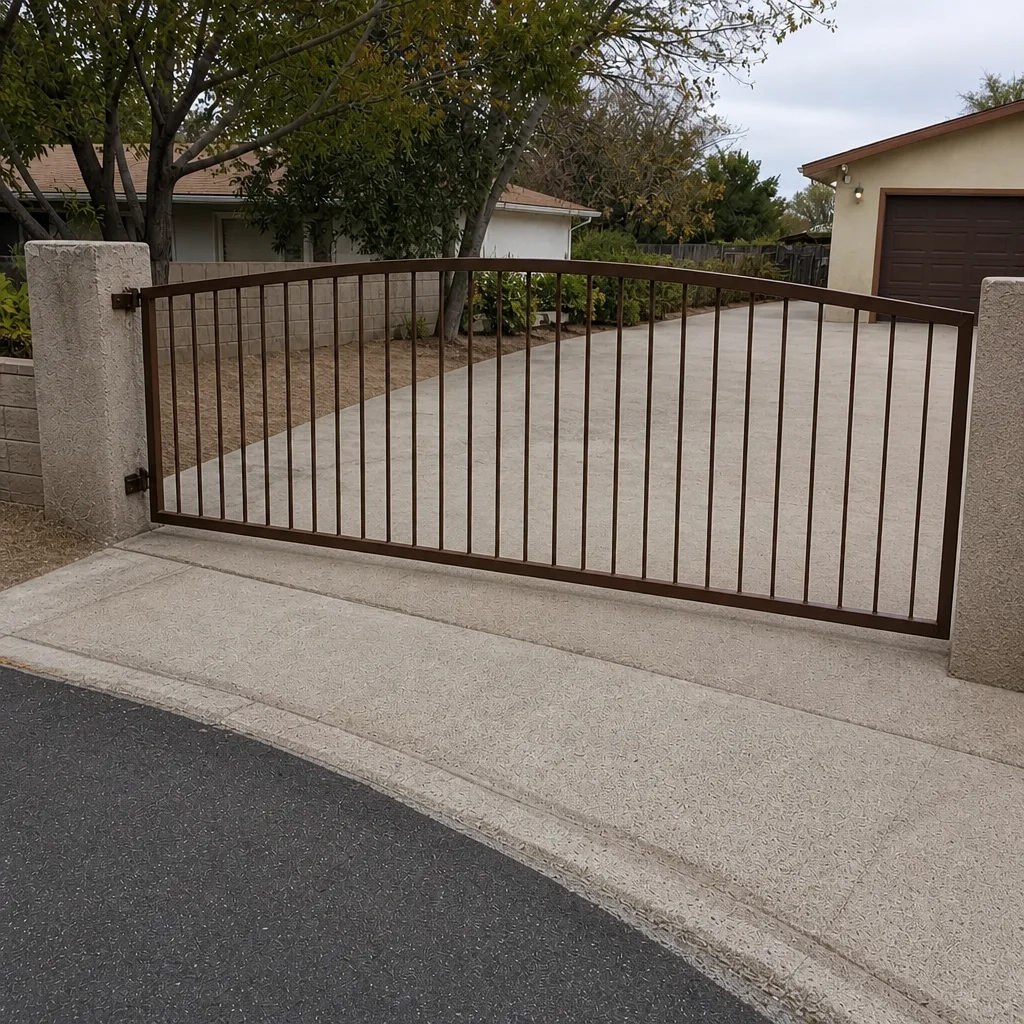
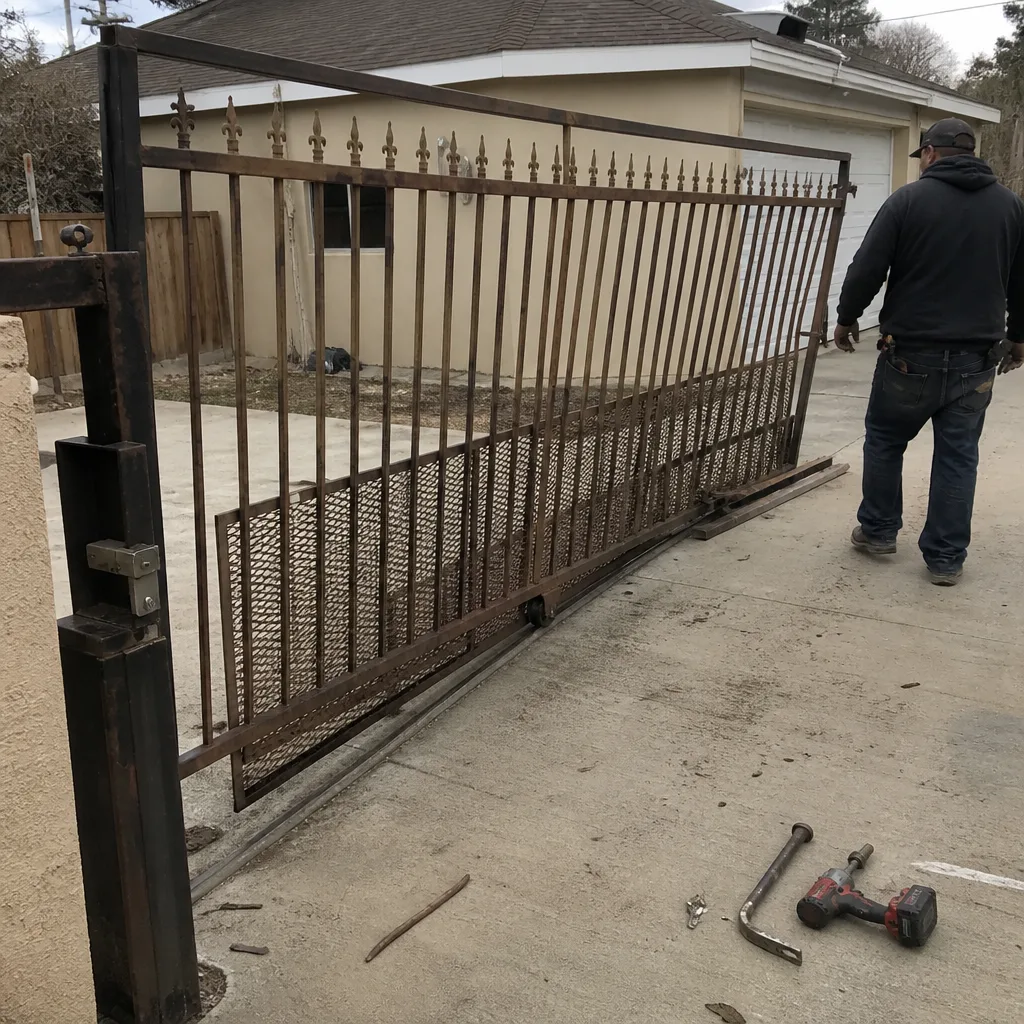
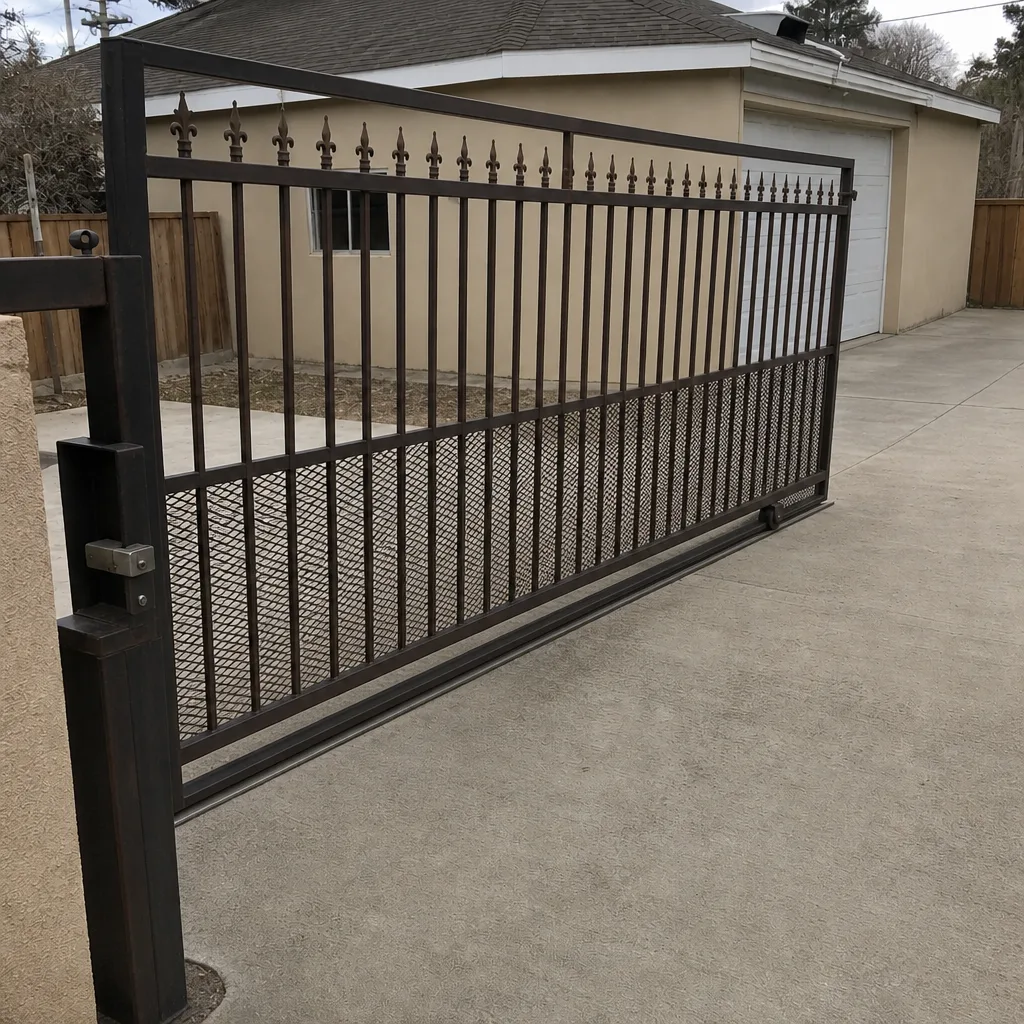
See the difference
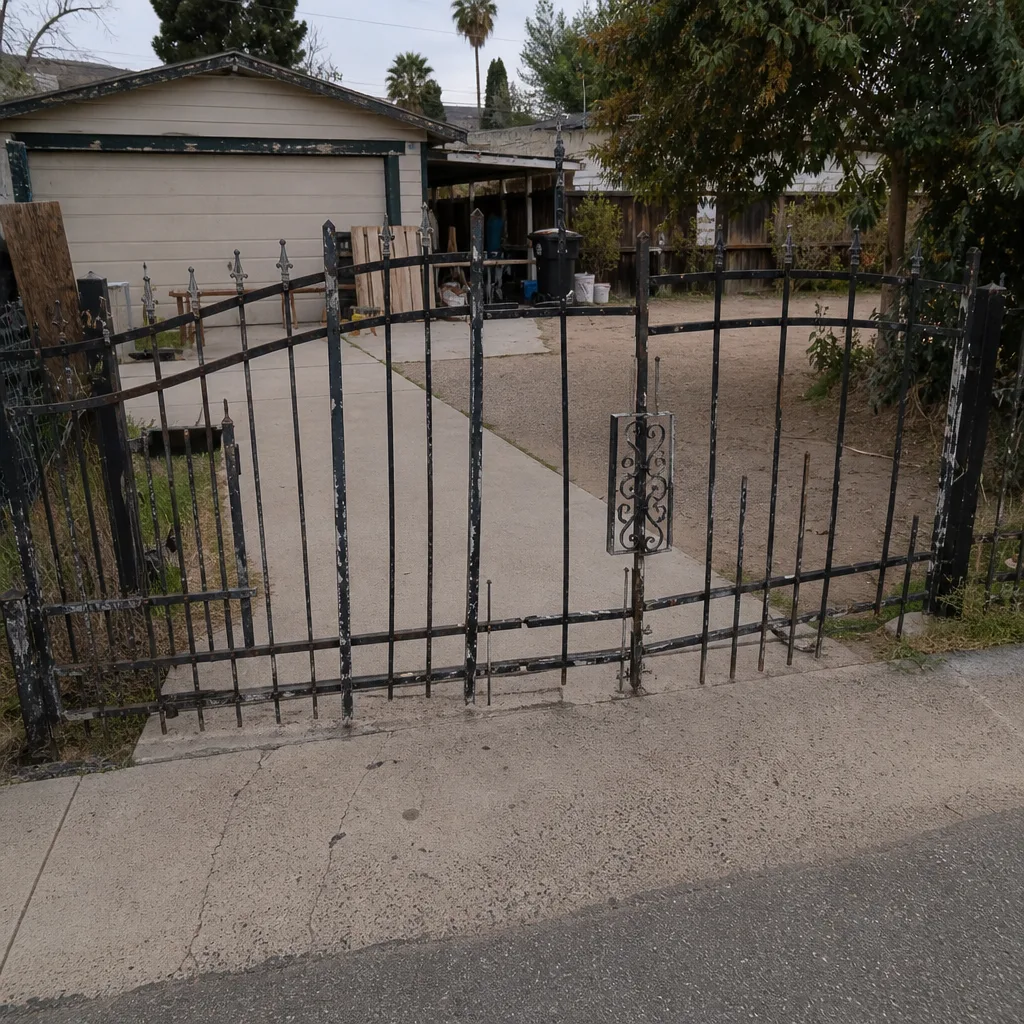 Before
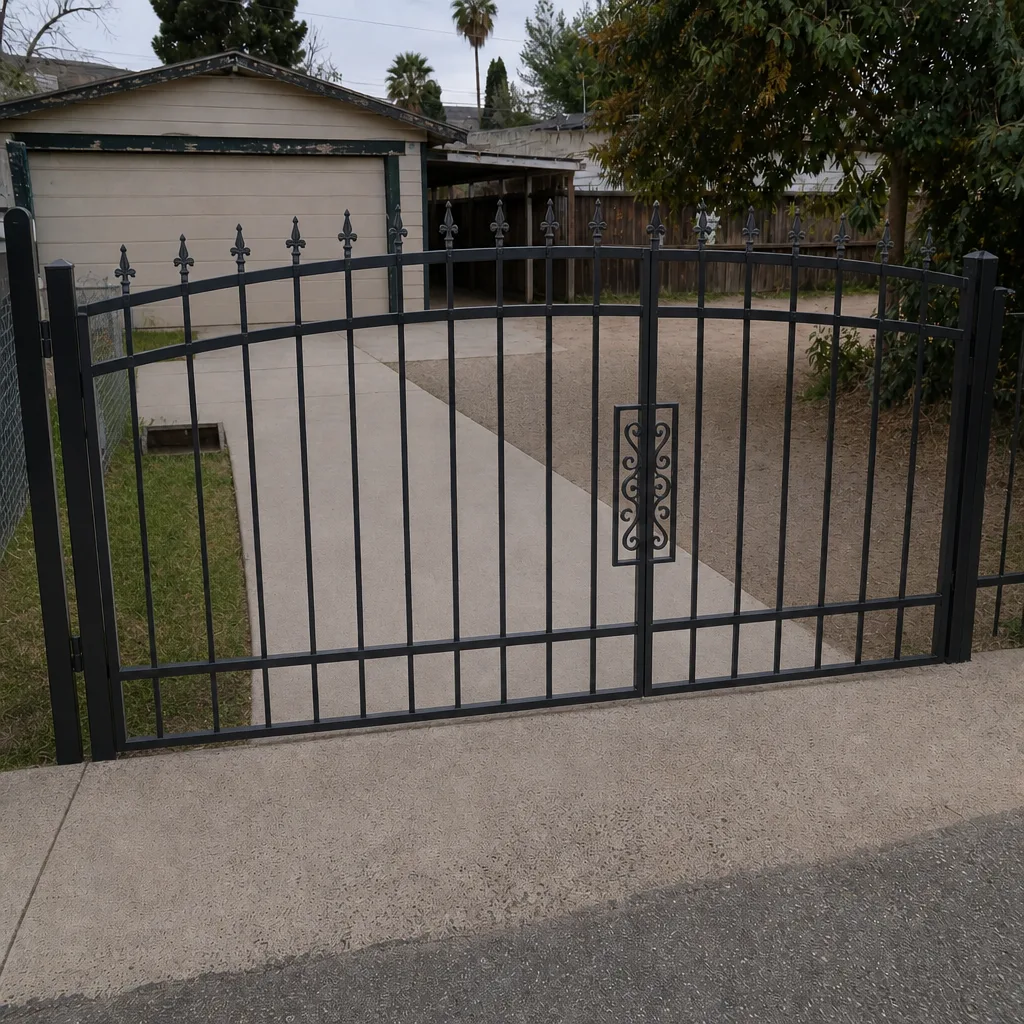 After
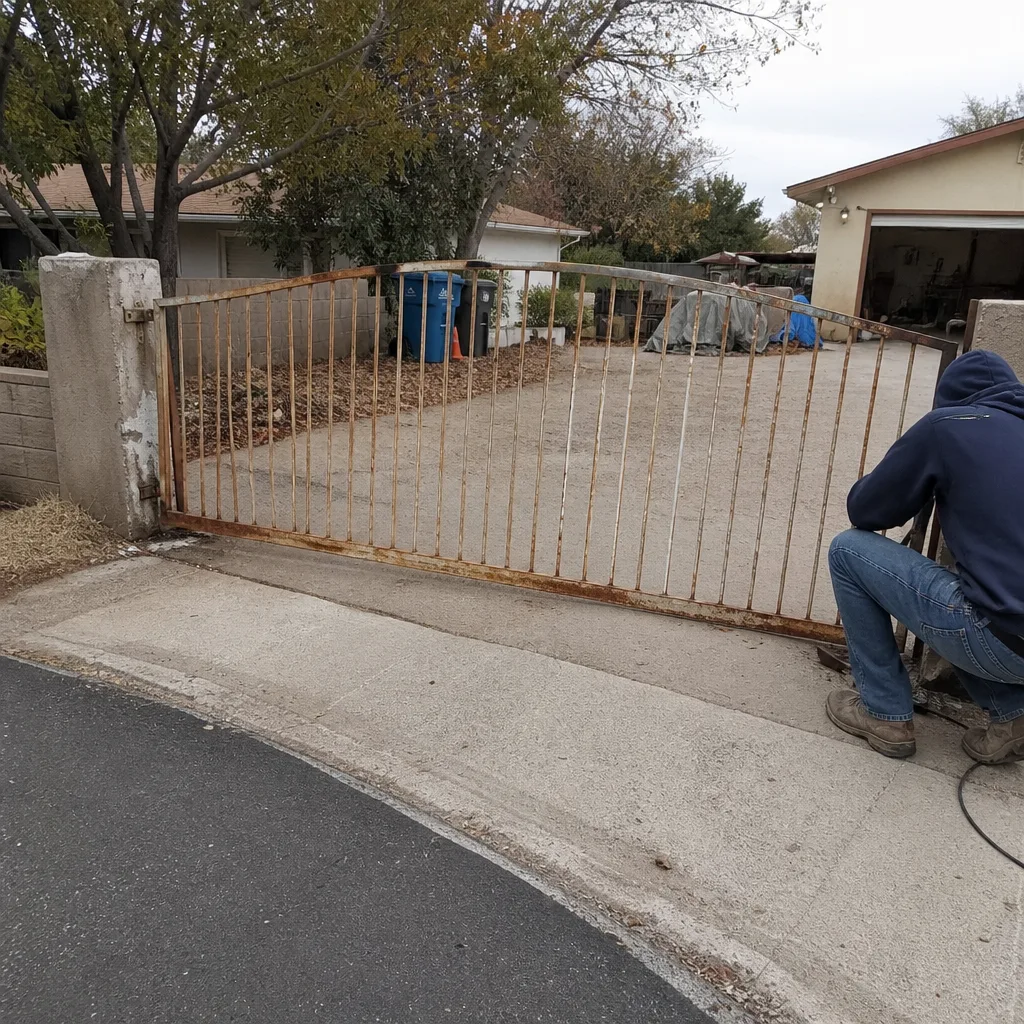 Before
 After
 Before
 After
When to Call a Professional
Some jobs are fair for a homeowner to do; tightening a bolt and flushing a weep hole are two of them. Others aren’t. If a hinge post is loose in its footing, if a chain or screw drive is grinding, if your operator isn’t reversing on obstruction, if any part of the gate falls under tensioned cable or torsion-spring control, or if a repair keeps coming back after you’ve tightened things twice – those calls need a trained hand. The safety edges, photoelectric sensors, and the low-voltage wiring to your operator all describe a system where getting it wrong means a gate that runs when it shouldn’t or stops when it must not.
The 90-Day Done Right Promise covers every job we do in Paradise: if it isn’t right, we come back. Call (888) 292-7536 for a free estimate, and free second opinions on any written estimate are always on the table. We fix the gate in your driveway before we ever talk about hauling it off – on-site welding, on-site diagnosis, on-site repair.
Frequently Asked Questions
Monthly visual checks and deep cleans in January, May, and October. Paradise’s heat and hard water mean maintenance intervals shorter than what national guides recommend – treat the summer months as active inspection season, not a break.
Hard-water mineral buildup inside the operator housing, alkaline desert dust in the gears, and heat cycles above 110°F cooking the wrong lubricant. Any of these alone shortens motor life; together they’re the classic Paradise failure pattern.
A high-temperature lithium-complex grease rated for at least 300°F for hinges and post pivots, and a dry-film PTFE spray for chains and tracks. Avoid WD-40 as a lubricant and any general-purpose household oil.
Yes, if you can find the openings and flush with a low-pressure hose before monsoon season. If the housing looks heavily clogged, water condensation has been sitting inside, or the motor doesn’t sound right, call us – flushing a clogged housing that’s already damaged won’t help.
Run the two-minute visual inspection and look specifically for water pooling around the gate footings, rust bloom on bare metal, and any operator hesitation on the first cycle after the storm. Photograph anything you see and log the date. Call us if a problem recurs.
We’re certified to service nine major gate brands including LiftMaster, FAAC, BFT, Linear, Viking, Ghost Controls, DoorKing, Elite, and Mighty Mule. If your gate isn’t on that list, call (888) 292-7536 and we’ll tell you honestly whether we can help or whether you need a brand-specific specialist.
The Bottom Line
A Paradise gate is not a coastal gate and not a Midwest gate. It faces alkaline dust, hard water, and sustained 115°F heat, and a checklist that ignores those specific pressures will leave you with a failed motor while you think you’re doing everything right. Monthly two-minute inspections, a high-temp grease routine, pre-monsoon weep-hole flushes, and a photo log will get years more out of any gate – and they’ll catch most problems while a repair is still cheap. If something’s nagging at you that the checklist doesn’t cover, call us at (888) 292-7536 for a free estimate. We answer the phone with a live person, around the clock.
For everything else we do in Paradise, start at the Gatewood Fence & Gate Paradise home page, and see what a gate repair visit actually looks like.
Written by the team at Gatewood Fence & Gate Paradise.