
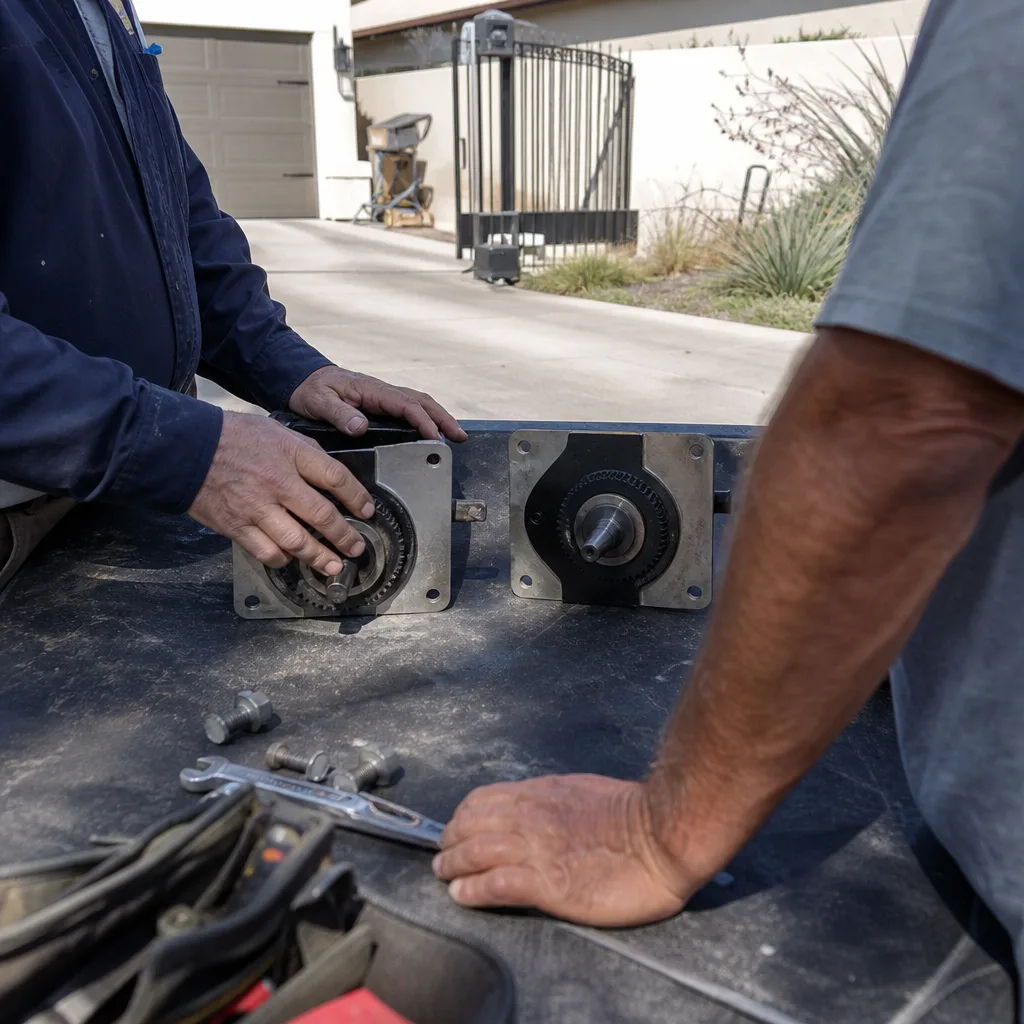
Last updated November 18, 2026
 Wrought iron
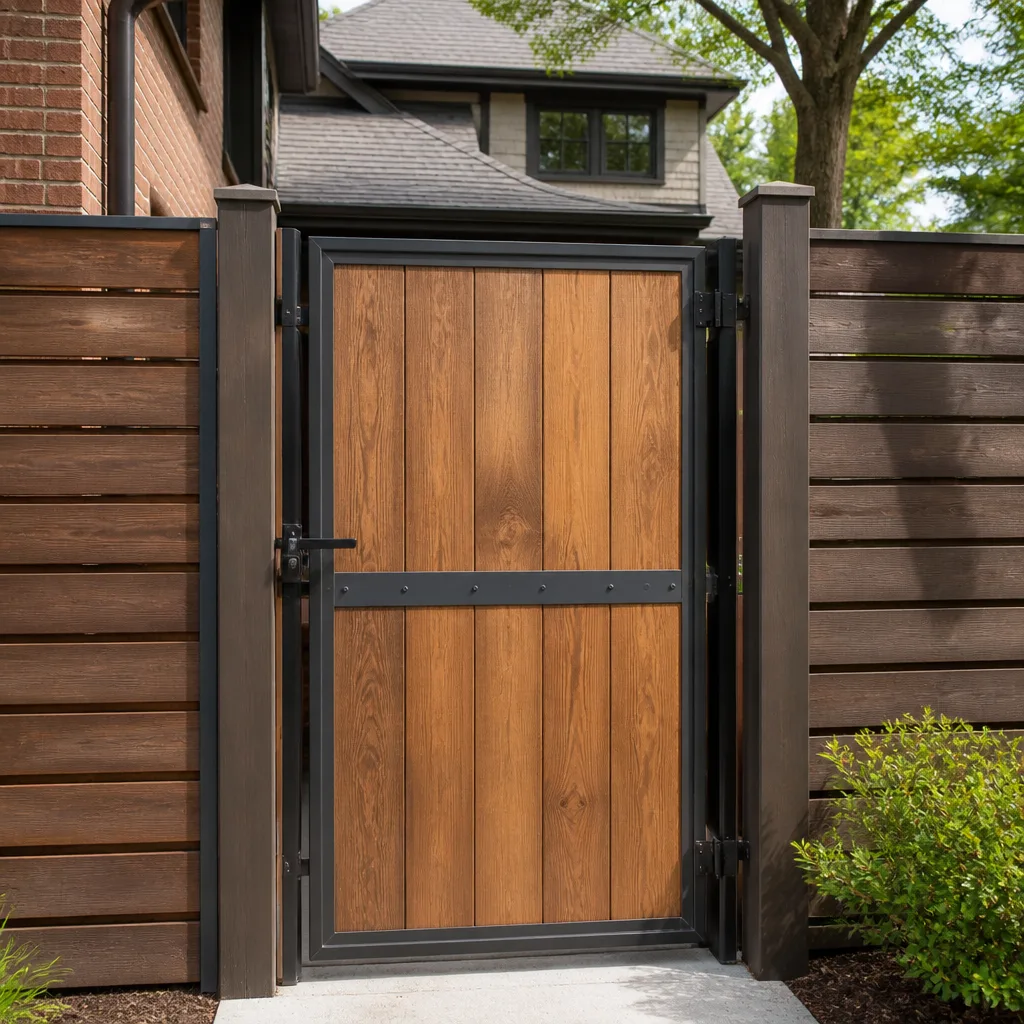 Wood & steel frame
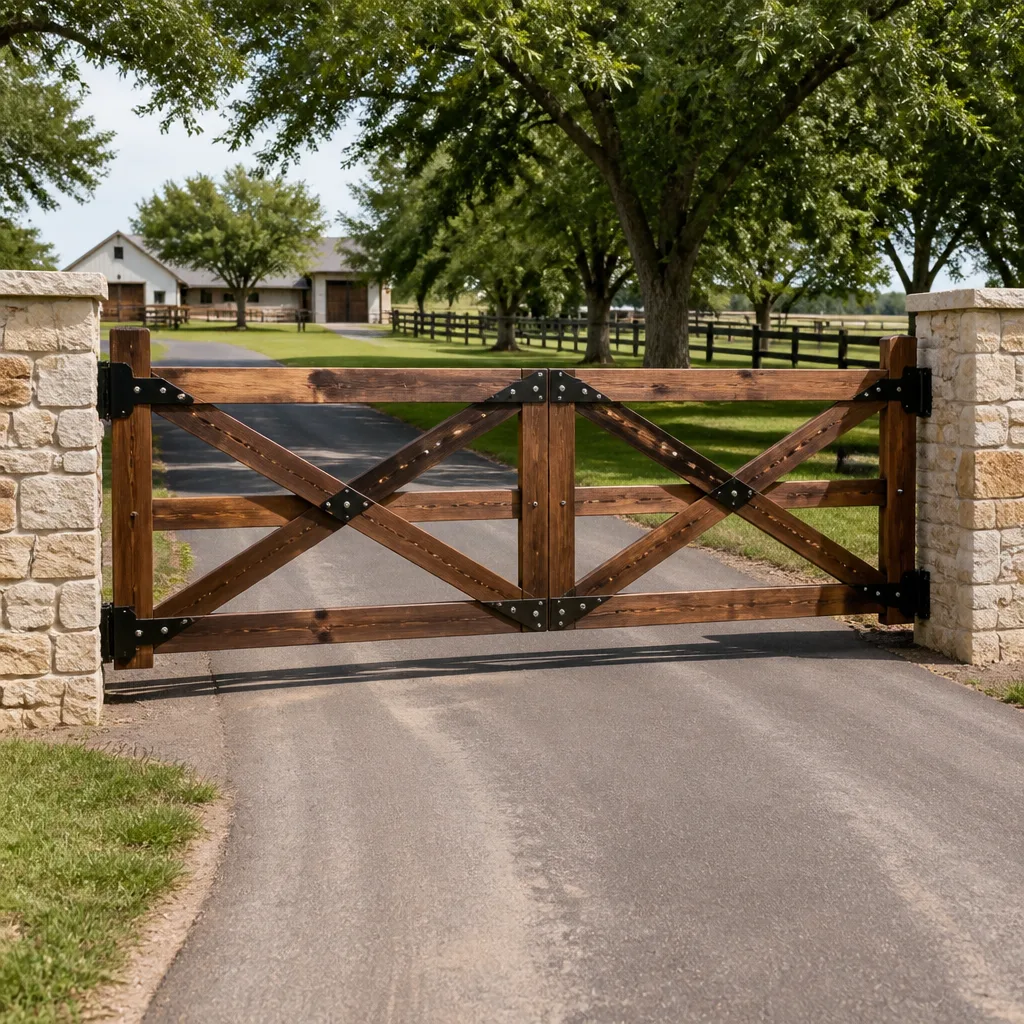 Farm & ranch
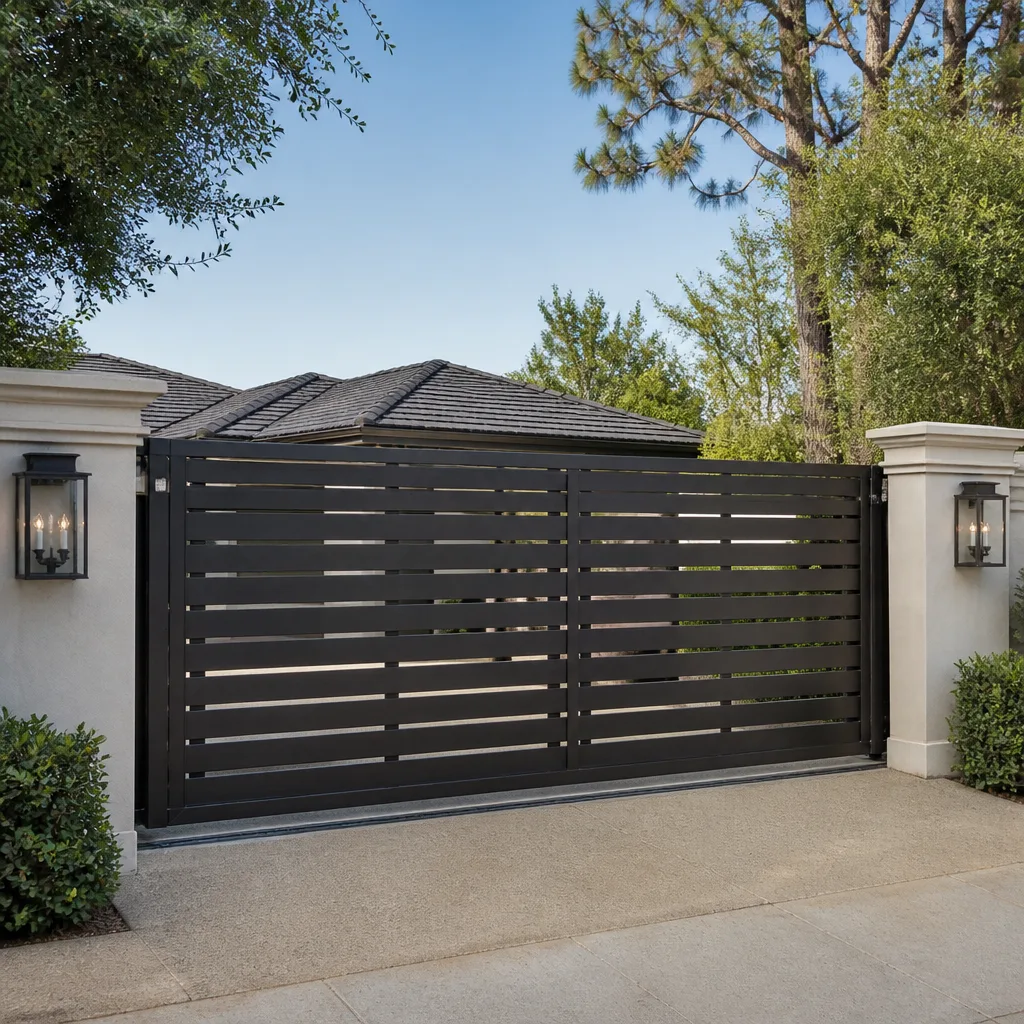 Sliding driveway gates
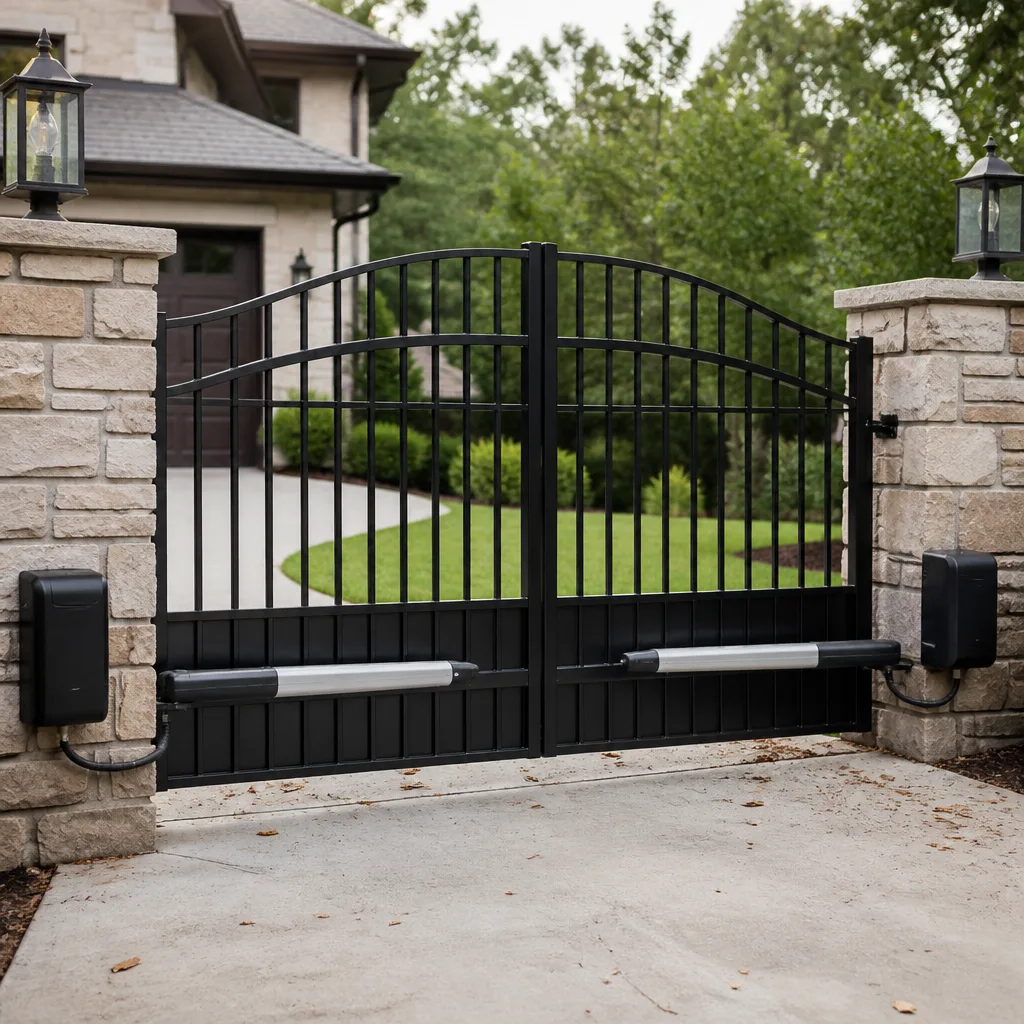 LiftMaster operators
Free on-site gate assessment - hinges, posts, and your LiftMaster or Nice gate operator checked before anything is quoted
The assessment is free and the quote is the invoice.
Get your free estimateGate Repair Troubleshooting: Common Problems and How to Fix Them
When a gate quits on a Friday night, it feels like it happened all at once. It almost never did. We’ve been fixing gates long enough to know that nine out of ten service calls trace back to one of five problems, and three of those five gave warning signs for weeks before the gate finally stopped. The gate was “acting weird” and it got written off. This guide walks through the five failures we see most, how to tell them apart, and a five-minute inspection you can run yourself so the next failure doesn’t catch you off guard. If you’re in Paradise or anywhere nearby, most of this will look familiar.
Quick Answer
Most gate failures come down to five causes: a failing hinge or hinge post, a dead battery or charging problem in an automatic opener, worn rollers or tracks, an operator that’s out of adjustment, or a broken weld. The symptom tells you which one you’re dealing with – a gate that hesitates points to power or control, a gate that reverses points to the safety circuit, and a gate that sags or drags points to the structure. Diagnosing the symptom correctly before touching a part is what saves you money.
Styles & brands we work with
- Wrought iron
- Wood & steel frame
- Farm & ranch
- Sliding driveway gates
- LiftMaster operators
Table of Contents
- A Gate That Hesitates vs. a Gate That Reverses: Two Very Different Problems
- How to Tell If a Sagging Gate Is a Hinge Problem, a Post Problem, or a Weld Failure
- Battery Backup Troubleshooting: Controller, Battery, or Solar Panel?
- Why Lubricating a Grinding Gate Often Makes It Worse
- The Five-Minute Visual Inspection We Run Before Touching a Tool
- Brand Matters: What We Look For on Linear, Viking, Ghost Controls, and DoorKing Operators
- What the Paradise Heat Does to Gate Hardware
A Gate That Hesitates vs. a Gate That Reverses: Two Very Different Problems
We hear both words used interchangeably, and they point in completely different directions. A gate that hesitates – pauses mid-travel, stutters, or starts slow – is usually a power, control, or mechanical drag issue. A gate that reverses – starts to close, then stops and backs off – is almost always a safety circuit problem. Misdiagnosing one as the other is the single most expensive mistake we correct on callbacks.
What “hesitates” usually means
- Low battery voltage or a failing backup battery that can’t hold a charge
- A control board that’s getting weak signals from the limit switches
- Mechanical drag – a hinge, roller, or track that needs attention
- On solar units, a panel that isn’t producing enough to keep up
What “reverses” usually means
- A photo-eye or safety edge that’s blocked, dirty, misaligned, or wet
- A loose wire in the safety loop making intermittent contact
- A limit switch set too tight against the physical stop
The reason this distinction matters: if you replace a motor because the gate “keeps reversing,” you’ve spent real money on a problem that was a $20 photo-eye. In Paradise, we see a lot of safety-loop issues after a monsoon blows dust and debris into the photo-eye housing. Clean the lens first, then call if the reversal persists. For a full walkthrough of what a proper operator diagnostic covers, see our Gate Motor & Opener in Paradise page.
How to Tell If a Sagging Gate Is a Hinge Problem, a Post Problem, or a Weld Failure
A gate sags at the hinge post, not in the middle – and that’s where we start. The gate is a lever arm, and every bit of stress lands on the top hinge and the post that holds it. Fix the panel without fixing the post and you’ll fix it twice. Here’s how to tell the three apart before you spend a dime:
- Open the gate a foot and let it sit. If the sag disappears when the gate is partially open, it’s a hinge or post issue. If the sag remains regardless of position, it’s a bent frame or a weld failure.
- Grab the gate post and push it. If the post moves or wiggles at all, the problem is the post – usually rust at the base, a cracked concrete footer, or a post that was never set deep enough. This is a structural fix, not a hinge swap.
- Run a hand along the top hinge and look for rust streaks or elongated bolt holes. If the hinge has wallowed out its holes, replacing the hinge is the fix.
- Look at every joint for a hairline crack in the paint. A weld failure almost always shows a fine crack in the finish before the joint separates. On a steel gate, that line is where the weld is failing.
The cheapest of the three is a hinge replacement. The most expensive is a post – and the most often missed is the weld crack, because it doesn’t affect the gate until the joint finally lets go. If the post itself is moving, that’s the kind of structural repair that needs to be welded in place rather than hauled off to a shop. That’s the work we do – on-site, in your driveway. Our Gate Repair in Paradise page covers what’s involved.
Battery Backup Troubleshooting: Controller, Battery, or Solar Panel?
When an automatic gate starts acting up after the sun goes down, the instinct is to blame the battery. Half the time it’s the controller or the solar panel, and the sequence below rules them out in order before you buy parts:
- Check the panel voltage first. On a solar unit, measure voltage at the panel leads in full daylight. If the panel isn’t producing, nothing downstream can work right. Dust film on a Paradise panel is common and easy to miss.
- Isolate the battery. Disconnect the battery and see whether the controller still powers up on AC. If it does, the controller is probably fine and the battery is the suspect.
- Test the battery under load, not just at rest. A battery can read a happy voltage and still fail under the draw of a motor. A load test tells the truth.
- Look for charging voltage at the battery terminals with the unit running. If the controller isn’t sending charge back, you’ll replace batteries in a loop forever.
- Walk the control wires. On a Linear or Viking chassis, a chafed wire near the hinge can act like a dead battery. It’s worth five minutes to check the run before you spend money on parts.
If you’ve done all five and the gate still acts up, that’s a controller-level call. We answer the phone around the clock at (888) 292-7536 – a live person, not a voicemail – and we can usually tell from the symptom whether it’s worth a visit or a simple reset over the phone.
Why Lubricating a Grinding Gate Often Makes It Worse
Grinding is not a lubrication problem. Grinding means two pieces of metal are being forced past each other when they shouldn’t be touching. Spraying lubricant on a grinding gate doesn’t fix the misalignment – it traps grit in the joint, holds it against the metal, and turns a slow wear problem into a fast one. If you’ve greased a grinding hinge and the noise is louder two weeks later, that’s why.
What grinding actually indicates, in order of likelihood:
- A roller or wheel that’s worn flat and is dragging instead of rolling
- A hinge pin that’s seized and is grinding against the knuckle
- A track that has shifted out of line so the roller is running on its edge
- A gate frame that’s slightly bent and is rubbing at the latch or stop
- On an opener, a gear that’s worn or a drive that’s lost its alignment
The correct move with a grinding gate is to find the source of the interference before you touch a can of lubricant. Grease is for a joint that’s already clean and moving freely – not for a joint that’s telling you something is misaligned. In Paradise, dust is our enemy here: it collects in every open joint, and a well-meant shot of grease becomes a grinding paste.
The Five-Minute Visual Inspection We Run Before Touching a Tool
Before we open a toolbox on any gate, we walk the same five-minute inspection. You can run it yourself once a season and catch most failures while they’re still cheap:
- Walk the full swing or slide path. Look for anything that’s changed – a patio stone lifted by roots, a sprinkler head out of place, gravel pushed into the track. A surprising number of “the gate is broken” calls turn out to be a physical obstruction.
- Push the gate post. Any movement at all means the post is the problem, and you should stop there and call.
- Open the gate a foot, let go, and watch what it does. If it swings on its own, the post or hinge is out of plumb. If it stays put, the frame is straight.
- Look for rust streaks under hinges and at the base of the post. Rust runs tell you where water is pooling – on a desert gate, that’s usually where the morning dew collects and doesn’t dry.
- On an automatic gate, trip the safety devices by hand. Wave a hand through the photo-eye beam and press the safety edge. If either doesn’t reverse the gate, that’s a stop-now item – a safety circuit that doesn’t work is a serious risk, especially if children or pets use the gate.
If you find nothing on the visual, the problem is inside the operator or the electrical side. We recommend stopping there and calling a professional. Gate openers run on line voltage, and the drive components on a torsion-style gate store enough energy to injure a person badly if a spring or cable lets go without warning. That’s not a DIY repair – it’s the one part of this that we won’t talk a homeowner through over the phone. For anything electrical, be safe and get a trained hand on it.
Brand Matters: What We Look For on Linear, Viking, Ghost Controls, and DoorKing Operators
Different openers fail in characteristic ways, and knowing the brand saves diagnostic time. On Linear swing and slide operators, we start by checking the limit switches and the control board before we suspect the motor – the board is the more common failure. On Viking units we see a lot of hinge-side wire chafe and battery terminal corrosion. On Ghost Controls solar models, panel dust and battery health account for most no-start calls. On a DoorKing access control gate, the symptom is often at the keypad or the control head, not the gate itself.
We service nine major brands and keep track of the failure signatures for each – LiftMaster, FAAC, BFT, Linear, Viking, Ghost Controls, DoorKing, Elite, and Mighty Mule. If your gate has one of these heads and it’s acting up, call us and we can usually tell from the symptom whether you need a visit or a part. If your gate needs a full replacement, our Gate Installation in Paradise page covers what’s involved, and if you’re starting from scratch, the Gatewood Fence & Gate Paradise home page is the best place to start.
What the Paradise Heat Does to Gate Hardware
Gates in Paradise live under conditions that eat hardware faster than most places in the country. Summer surface temperatures on exposed steel can push well past what the metal was finished for, and the daily swing between a hot afternoon and a cool desert night works every joint, every hinge, and every weld. What we see specifically in Paradise:
- Post base rot on steel gates – water collects in the base of the post where the footer meets the metal, and the accelerated drying cycle speeds rust at the ground line. That’s usually the weak point before anything else on the gate.
- Hinge wear at the top gate – the top hinge carries more load than the bottom, and the heat cycles work it loose faster.
- Photo-eye failures after dust events – a spring dust storm coats the lens and the gate “reverses” every close. Clean first, don’t call for service until you’ve wiped the lens.
- Solar panel film – on any solar-charged operator, the panel needs a wipe every few months or the battery never gets a full charge and starts failing early.
- Expansion joints opening up – on long slide gates, the metal grows and contracts enough on a Paradise summer day to shift tolerances. That’s the root of a lot of “the gate suddenly started grinding” calls.
None of this is exotic – it’s just what happens when you leave hardware outside in the sun for a decade. The good news is that most of it is catchable on the five-minute inspection if you run it a couple times a year. If you’d rather have a second set of eyes on it, we’ll come look. No trip charge inside the county.
Common Mistakes to Avoid
- Replacing the motor when the safety circuit is the problem. A reversing gate is almost never a dead motor. Nine times out of ten it’s a photo-eye, a safety edge, or a loose wire – and a $20 part fixes what a $900 motor won’t.
- Fixing the gate panel without fixing the post. A sagging gate might look like a hinge problem; if the post is moving, the panel fix will fail in a season. Push the post first.
- Greasing a grinding gate. Grease on a misaligned joint traps grit and accelerates wear. Find the interference, then lubricate the joint that’s actually clean.
- Ignoring a hairline crack in the paint at a weld. That line is a failing weld telling you it’s about to go. Catch it now and it’s a repair; catch it after the joint separates and it’s an emergency.
- Blaming the battery without testing the panel. On a Paradise solar operator, a dusty panel is a more common failure than a dead battery – and it costs nothing to check.
- Welding a gate off the hinges. Hauling the gate to a shop sounds efficient, but it means your gate is gone for days and the post sits unloaded, which can shift it. We weld in the driveway so the gate stays put.
- Calling a national outfit that quotes on the phone and charges at the door. Ask for the quote in writing and confirm the price is agreed before any work starts. That’s how pricing should work everywhere, and it’s how we run it.
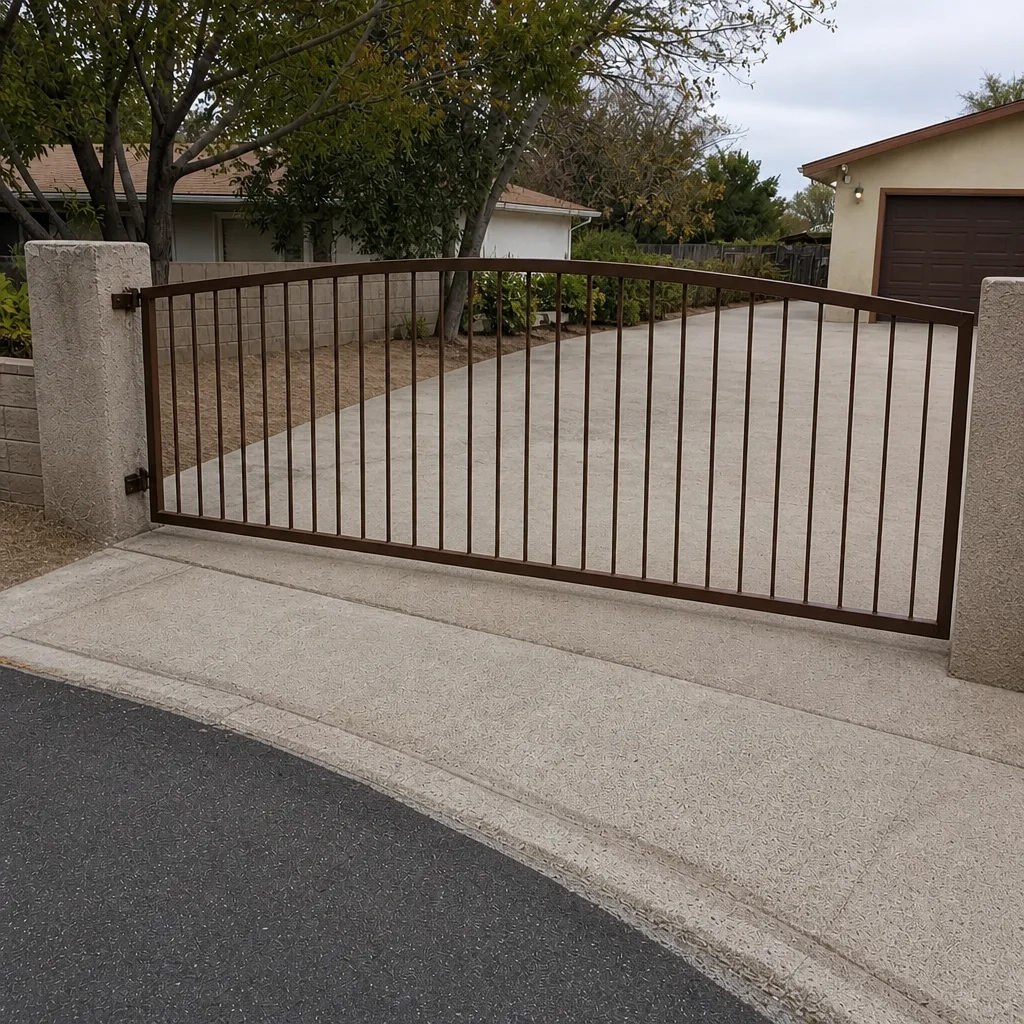
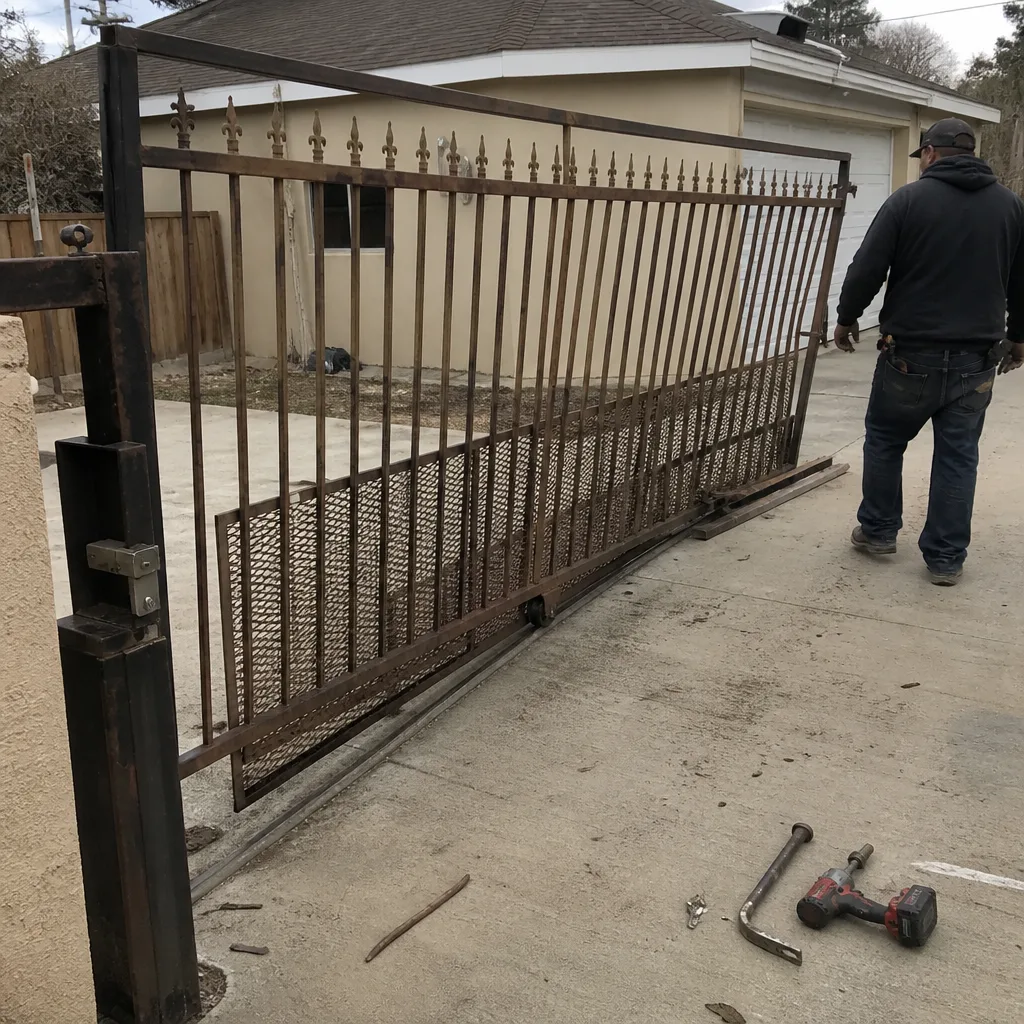
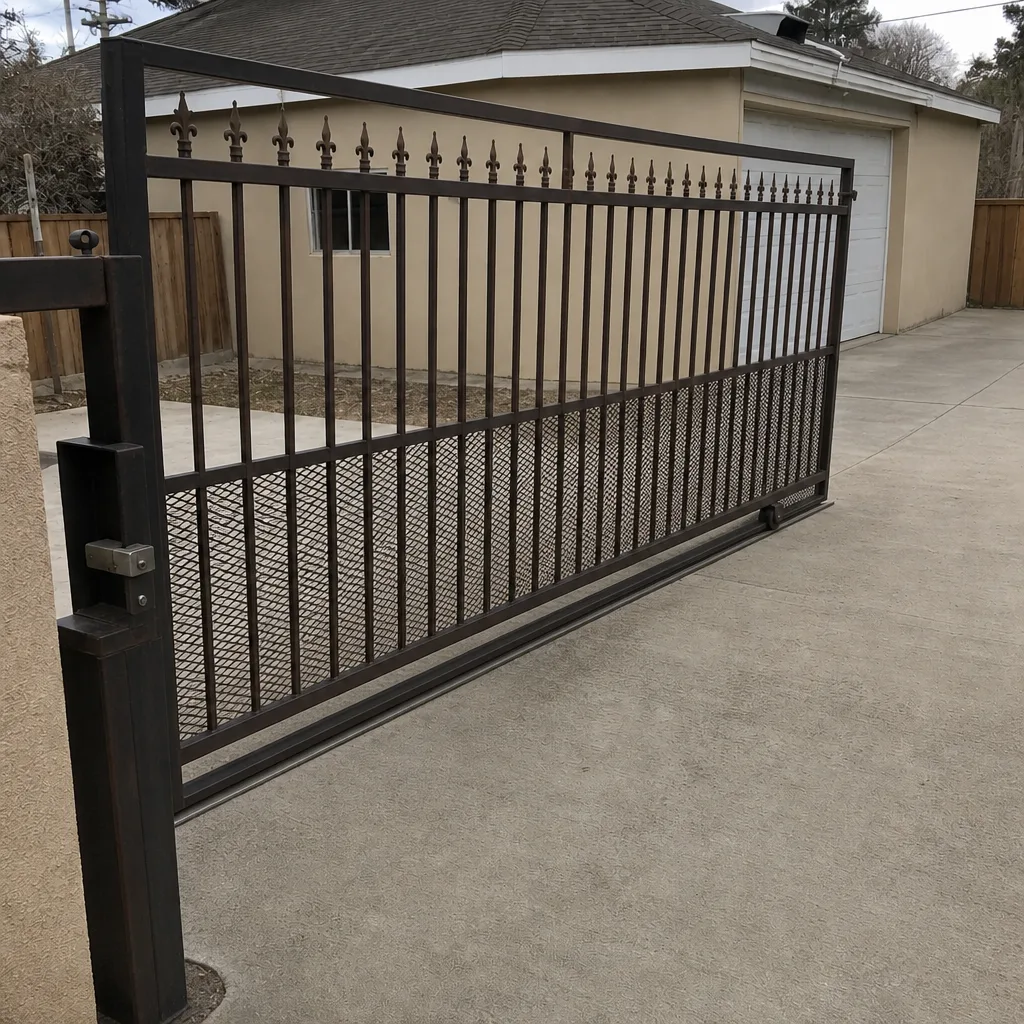
See the difference
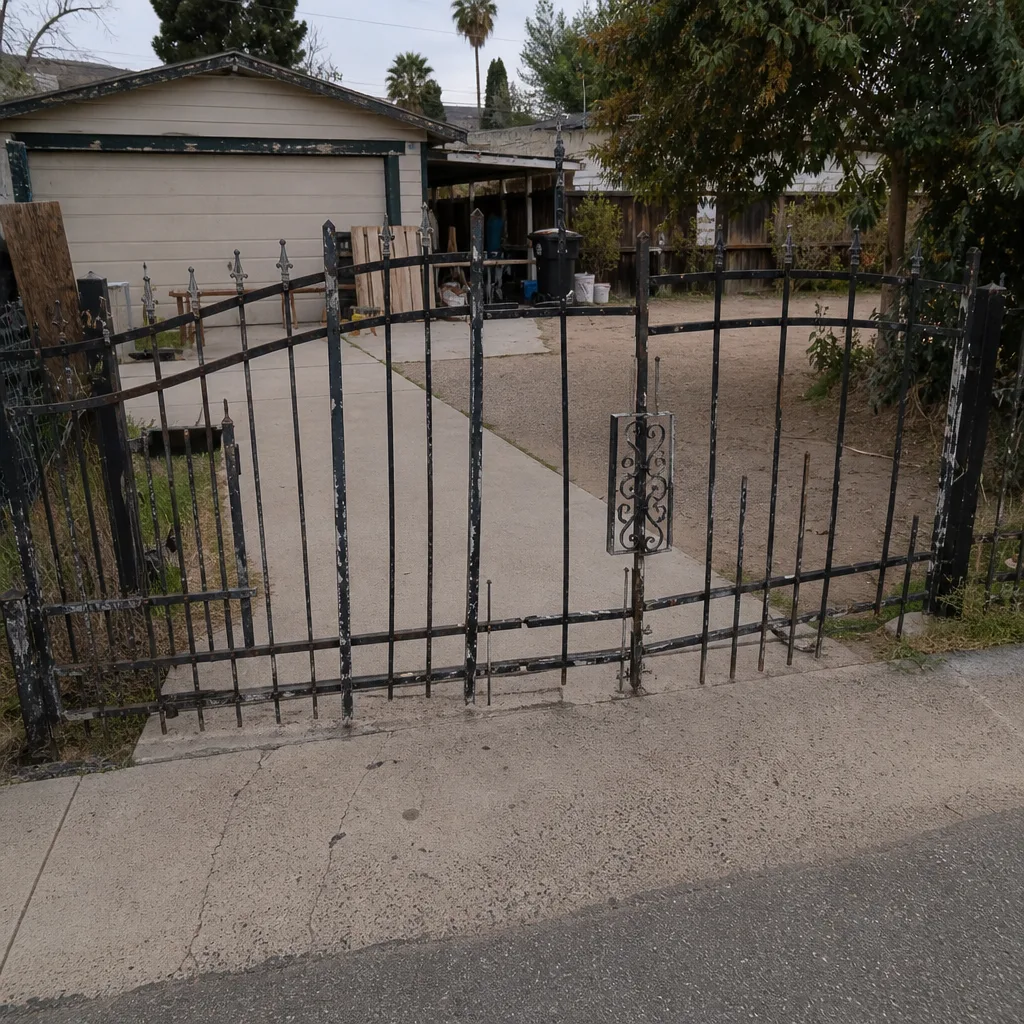 Before
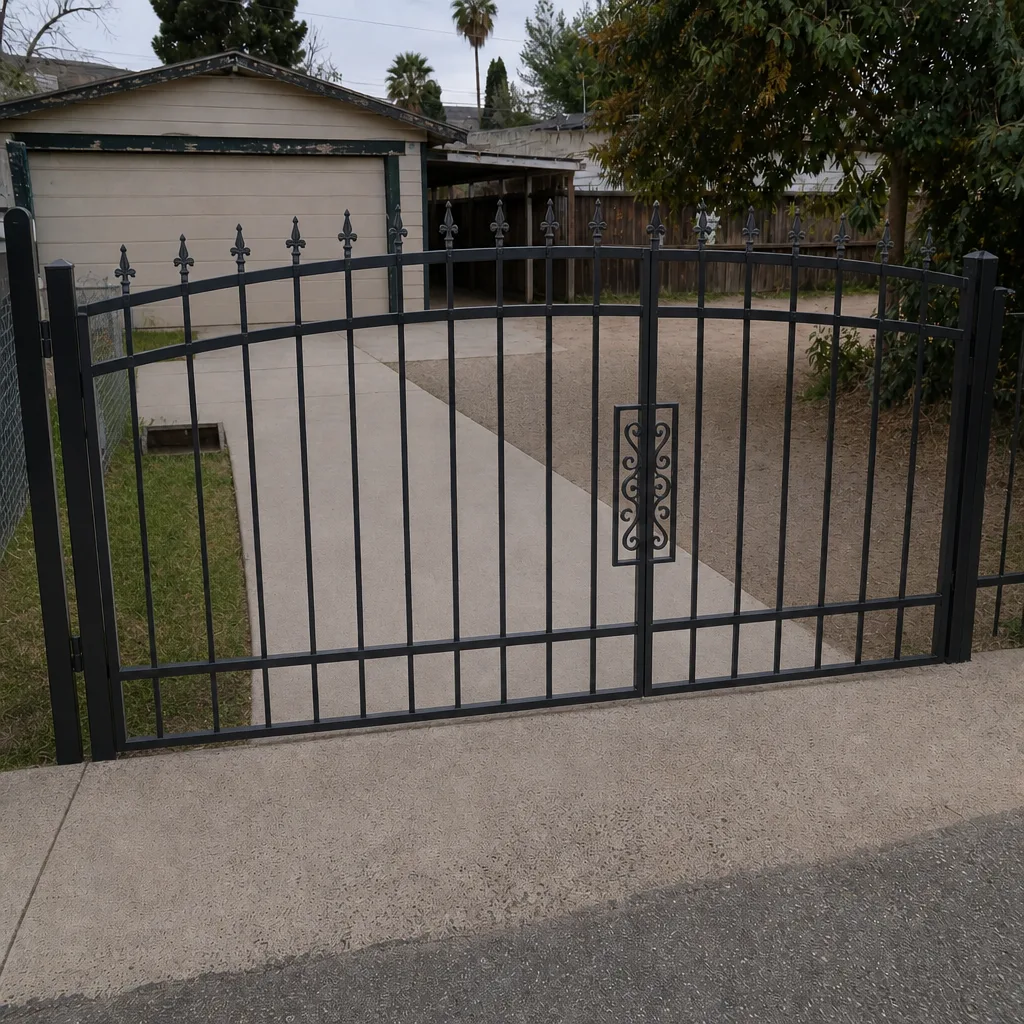 After
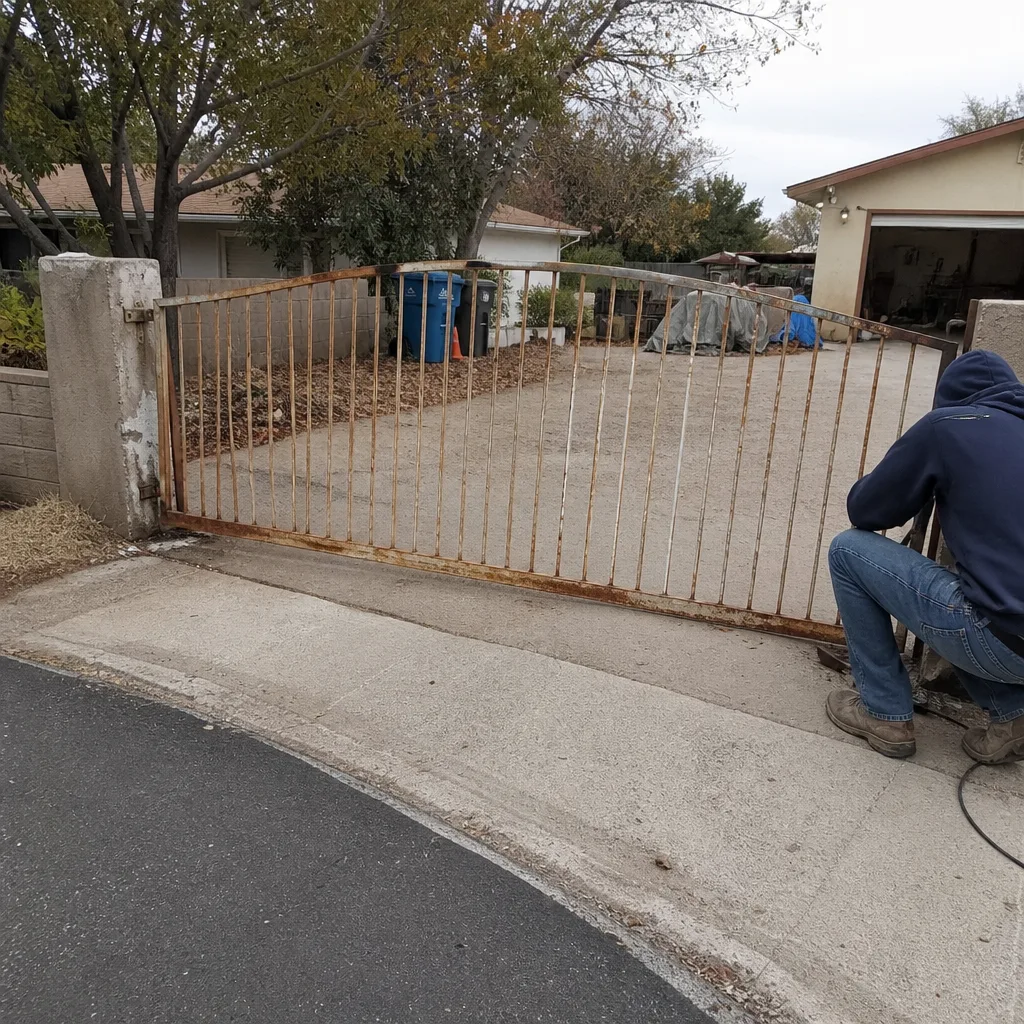 Before
 After
 Before
 After
When to Call a Professional
Call a pro if the gate post moves at all, if a weld is cracked, if the operator is showing a fault code you can’t clear, or if anything on the safety circuit isn’t reversing the gate reliably. Those are the four we don’t recommend a homeowner tackle, and the last one is a genuine safety issue if children or pets use the gate. Anything involving line voltage at the opener needs a trained hand – gate operators run on household current and the drive springs on a torsion setup store enough energy to cause serious injury. Don’t test those by hand. Gatewood Fence & Gate Paradise offers free estimates in Paradise – call (888) 292-7536 and we’ll be straight with you about whether it needs a visit. A live person answers, around the clock.
Frequently Asked Questions
Most repairs in Paradise land in the $150 to $450 range depending on what’s actually wrong – a hinge replacement is at the low end, a post repair or an operator board is at the high end. We quote upfront and agree the price before we start, and we don’t change it at the door. If your repair runs over $200, we take $40 off as a standing offer. Call (888) 292-7536 for an exact quote – estimates are free.
On repair calls, usually yes. We answer the phone around the clock at (888) 292-7536 and can often get to a Paradise gate the same day, especially if the gate is stuck open or won’t close. Installation and full replacement jobs are measured, ordered, and scheduled – different timeline. Call and we’ll be honest about the window.
A gate that reverses on its own with nothing in the way is reacting to a false signal from the safety circuit – a dirty photo-eye, a misaligned beam, or a wet connection. Clean the photo-eye lens first. If it still reverses, that’s a circuit issue worth a call. Don’t disable the safety edge to make it close; that’s a real risk to anyone who walks through the gate.
Almost always the battery. A full opener replacement is the last resort, not the first, and we’ll test the battery, the panel, and the charging circuit before we suggest a new operator. On a Linear or Ghost Controls chassis, the battery and the panel are both cheaper than the board and the board is cheaper than the opener. We work through them in that order.
Yes. We weld in the driveway so your gate stays hung on the post where it belongs, rather than getting loaded onto a trailer and hauled off. That matters more than people realize – a gate that goes off its hinges for a week can shift the post, and then you’ve got a second repair. On-site is the right way to fix a weld. Every job we do carries the 90-Day Done Right Promise in writing.
A full installation includes the post set, the gate hung and aligned, the operator and any access control wired and commissioned, and the safety edges and photo-eye tested to reverse properly. It’s a measured job – we come out, measure, and give you a written price before anything is ordered. If you want a second opinion on another company’s written estimate, that’s free. Call (888) 292-7536.
The Bottom Line
Almost every gate failure announces itself before it happens. A gate that hesitates is a power or drag issue; a gate that reverses is a safety-circuit issue; a gate that sags is a post, hinge, or weld problem. Diagnose the symptom before you touch a part, run the five-minute inspection once a season, and don’t grease a grinding gate until you know what’s grinding. If you’re in Paradise and something’s telling you it’s about to go, call (888) 292-7536 for a free estimate. Live person, around the clock, no trip charge inside the county, and a 90-Day Done Right Promise in writing on every repair we do.
Written by the team at Gatewood Fence & Gate Paradise.