
Last updated November 18, 2026
 Wrought iron
 Wood & steel frame
 Farm & ranch
 Sliding driveway gates
 LiftMaster operators
Free on-site gate assessment - hinges, posts, and your LiftMaster or Nice gate operator checked before anything is quoted
The assessment is free and the quote is the invoice.
Get your free estimateGate Parts & Welding Warning Signs Every Homeowner Should Know
Paint bubbling on a hinge plate isn’t a cosmetic problem. It’s rust working from the inside out through a stress fracture, and it usually means that hinge has maybe one season left before it separates under load. We’ve pulled gates off driveways in Paradise where the owner had been “keeping an eye on” a flaking hinge for two years, and the metal underneath was already cracked clean through. Most gate failures don’t happen without warning. The warnings just get misread as operator trouble or written off as normal wear. This guide teaches you to read the metal itself, not just the way the gate behaves, so you know the difference between a part that needs watching and a gate that needs to stay closed until somebody qualified looks at it.
Quick Answer
The warning signs that matter most are paint bubbling or rust streaking at weld joints, cracks at the primary hinge point, a hinge that screeches at a high pitch under load, a gate that tilts slowly over months, and a latch gap that keeps growing. A cracked weld at the main hinge is a stop-using-it-now sign, while a high-pitched hinge squeal or a worn roller is a schedule-a-repair sign. Learning to tell those two categories apart is the whole skill.
Styles & brands we work with
- Wrought iron
- Wood & steel frame
- Farm & ranch
- Sliding driveway gates
- LiftMaster operators
Table of Contents
- Why You Should Read the Metal, Not the Behavior
- What Paint Bubbling and Rust Streaking Actually Mean
- The Sound of a Failing Hinge vs. a Worn Roller
- Why a Slowly Tilting Gate Is a Post Problem
- Reading Latch Gap Changes: Seasonal vs. Structural
- The One Sign That Means Stop Using the Gate Today
- What On-Site Welding Can and Can’t Fix
- A Simple Monthly Inspection You Can Do Yourself
Why You Should Read the Metal, Not the Behavior
A gate is honest. It shows you what’s happening in the steel long before it fails. The problem is we tend to watch the gate move and judge it by that – it opens, it closes, so it must be fine. That’s backwards. A gate can swing smoothly on a hinge that’s two weeks from snapping, because the load path hasn’t fully let go yet. When it does, it happens fast, usually with a vehicle or a person right under it.
In our experience across Paradise and the surrounding rural counties, the gates that fail catastrophically are almost never the ones that looked bad last month. They’re the ones that looked fine at a glance because nobody got close enough to look at the welds. The metal at every joint on your gate is working under load every single time it moves. Hinge plates, latch brackets, corner miters, post flanges – those are the stress points, and those are where you should be looking with your hands and your eyes, not your remote. Once you start reading the metal, the gate stops being a mystery and starts being a checklist.
What Paint Bubbling and Rust Streaking Actually Mean
Paint bubbling is rust lifting from the inside. When moisture gets into a hairline crack at a weld, it starts corroding the steel beneath the paint film, and the corrosion produces more volume than the steel it replaces. That expansion pushes the paint up and out. By the time you see the bubble, the crack underneath is already there and has been for a while.
Here’s what the surface patterns tell us:
- Bubbling along a hinge plate or latch bracket: The bolt holes are wallowing out and moisture is getting behind the plate. Left alone, the bolts shear or the plate tears.
- Rust streaks running down from a weld seam: The weld is porous or fractured, and water is finding its way through to the inside of the tube. Tubular steel rusts from the inside, and you can’t see it until the wall thins to nothing.
- Orange stains fanning out from a corner or miter: Consistent with a stress fracture at the joint that has been flexing. That’s a weld that’s been working and needs to be ground out and re-welded.
- Blistering on the post itself, not the gate: Water is getting into the footing and wicking up the post. This is often the earliest sign of a footing problem.
If your gate lives under a sprinkler or drip line, or it’s on the north side of a house in Paradise where moisture hangs longer, bubbling will show up years sooner than it does on a dry, sun-baked gate. Same metal, different clock. What looks like a cosmetic touch-up to a painter is a structural warning to a welder. Those are different jobs.
The Sound of a Failing Hinge vs. a Worn Roller
Your ears can catch what your eyes miss. Two very different sounds come out of a gate, and they mean two very different things.
A failing hinge usually makes a high, tight, grinding or squealing noise that rises in pitch when the gate reaches a certain arc – typically as it loads up right at the point where the weight transfers. That’s a bearing in the hinge plate collapsing, or more seriously, a weld beginning to crack and the two faces grinding against each other. That sound is often worst in direct sun, and more interesting still, it often stops on cool mornings because the metal has contracted and the load path has shifted. A noise that goes away isn’t a noise that got fixed.
A worn roller sounds different: a low rumble or a rhythmic thunk as the gate travels the track, worst at the same spots every time, and often accompanied by the gate “hunting” side to side. A worn roller rarely fails catastrophically. A failing hinge can. Keep that in mind when you’re deciding whether to open the gate one more time on your way to the hardware store.
Wheel-and-track gates are common in this part of Paradise because of the long sloped driveways, and those tracks wear unevenly, which produces its own sounds. The point is to listen with attention for a week before you decide it’s nothing. Cheap intuition is expensive repair.
Why a Slowly Tilting Gate Is a Post Problem
A gate that has leaned two inches over six months is not a hinge problem, and swapping the hinges won’t fix it. Hinges do not slowly tilt – they either work or they fail. A gate that changes its angle slowly is telling you the hinge post itself is moving in the ground.
The cause is almost always footing-related:
- Hydraulic settling. The footing has shifted because the surrounding soil is moving. Common on sloped lots and lots downslope of a grade change.
- Footing undersized. A 2-inch post set in a 6-inch concrete plug is plenty for a mailbox and useless for a 12-foot gate. The post racks in the concrete.
- Water infiltration. A crack in the concrete at the base lets water in, and the first freeze of the year lifts the whole assembly a fraction of an inch. Do that for three winters and your gate is leaning.
- Post rot. Steel posts rust at the bottom, wood posts rot at the bottom. Either way, the section below grade is the one that matters and the one nobody looks at.
Here’s the thing people get wrong: they see the sag and they call us to fix the hinges. When we get out and look, the hinges are fine and the post needs resetting or a new footing poured. Fix the panel without the post and you’ll fix it twice. Any honest gate repair in Paradise starts by checking the posts before anything else is touched. It’s the difference between a repair that lasts and a repair that comes back next spring.
Reading Latch Gap Changes: Seasonal vs. Structural
The gap between the gate and the latch post is a diagnostic tool most homeowners never think to use. Watch it for a season and it will tell you what’s happening.
Some movement is normal. Wood posts move with the seasons, and even steel posts move with the soil. A quarter inch in the winter and out in the summer is well within tolerance. Metal expands and contracts with temperature. Ground heaves. This is why the same latch that needed a nudge in January works smoothly in June.
What’s not normal:
- A gap that grows and stays grown. If the gap has gotten bigger over several months and doesn’t come back, the frame is shifting.
- One side of the frame moves while the other doesn’t. This usually means one post is failing and the other isn’t. That’s a structural sign.
- The latch now sticks or misses on one side of the swing but not the other. That means the plane between the two posts has shifted, not that the latch itself is worn.
- The gap changed suddenly after a storm, a heavy truck going past, or a frost heave. That’s a footing event, not a seasonal one.
DoorKing and Linear latches are the most common ones we see on residential gates in our area, and both are forgiving of small seasonal movement. When they stop working, it’s almost always the frame, not the hardware. Trust the gap. When a gap changes, measure it – and measure it again next month. The number on the tape is more reliable than your memory.
The One Sign That Means Stop Using the Gate Today
A visible crack at the weld of the primary hinge plate means stop. Not reduce, not “keep an eye on it,” not “we’ll get to it next month.” Stop, and if you can, park the vehicles and don’t put a person through that gate until it’s been looked at by someone trained to recognize structural failure.
Here’s why we mean it. The primary hinge is where the entire gate load transfers into the post. When that weld cracks, the crack propagates under every single open-and-close cycle. The gate will keep working – for a while. Then, when it finally gives, an 8-foot gate can drop hundreds of pounds of steel, and if it’s on an operator, the operator keeps pushing until it hits something or shreds its own arm. We’ve seen a swing gate shear clean off a fatigued hinge with only the actuator chain holding it. That’s not a repair, that’s a recovery. The same rule applies to a bent gate axle, a split post flange, and a chain or toothed rack that has snapped and is being dragged along the frame.
If you’re not sure whether a crack qualifies, call and send us a photo. We’ll tell you on the spot whether it’s a “look at it this week” or a “don’t touch it.” Gate repair in Paradise is where we do this kind of work, and we’d rather look at a photo than an injury report.
What On-Site Welding Can and Can’t Fix
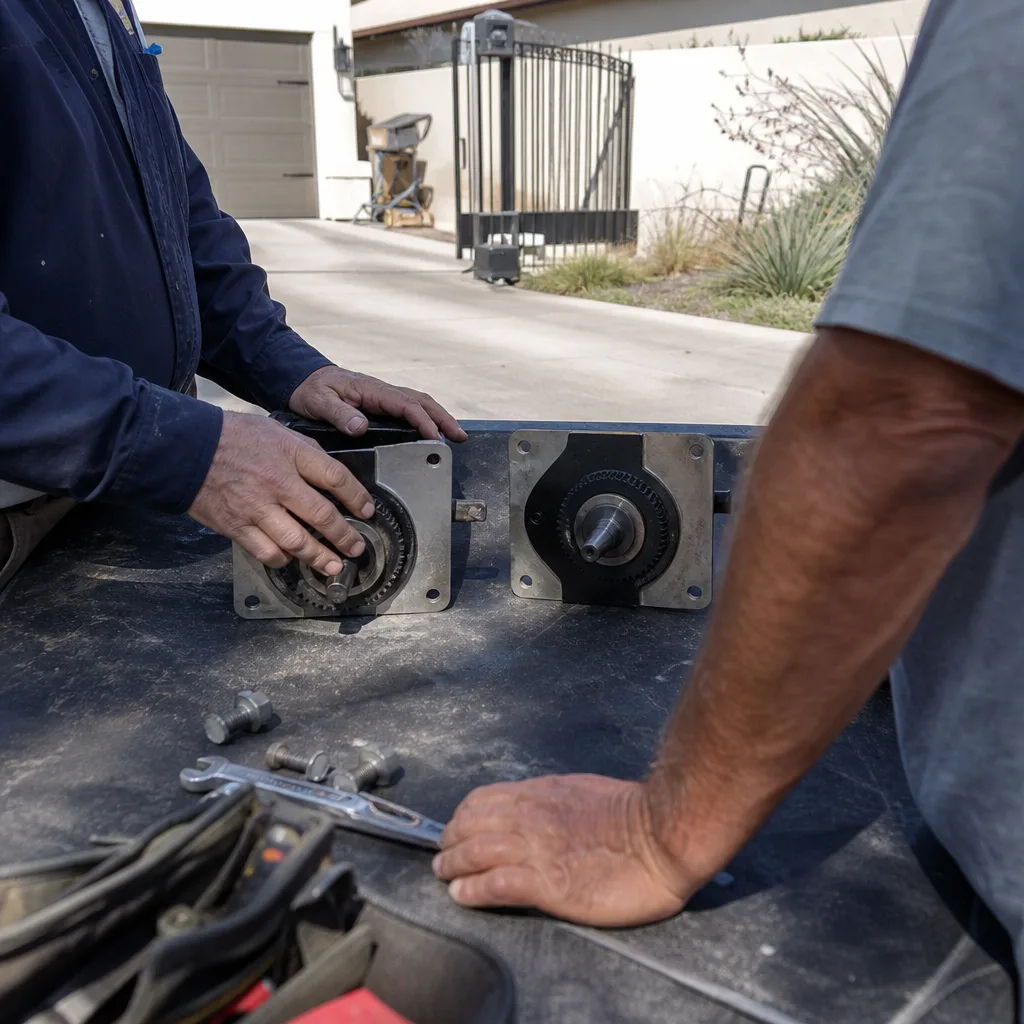
On-site welding means the gate stays in your driveway. We grind back to bare steel, cut out the failing weld, and run a fresh bead with the correct filler for the metal – all in place. There’s no towing it to a shop, no waiting weeks, and no chance of the panel getting twisted in transit. This is the biggest difference between a fix and a swap, and it’s why we keep a mobile welding setup on every repair call.
What we can fix on site:
- Cracked hinge plate welds (with proper post inspection first)
- Split latch brackets and corner miters
- Worn or broken wheel cradles and roller housings
- Accessory brackets for GateKing and linear operators, plus the reinforced pickets that hold them
- Panel-to-frame welds that have begun to fatigue
What we can’t fix with welding: a post that’s failed below grade, a footing that’s settled, or a rusted-through tube whose wall thickness is gone. Those need structural replacement, not a bead. Any honest welder (or any specialist – us included) should tell you which category your gate is in before work begins. No welding on top of rot or a failed post. You’d be fixing the wrong thing.
Compare that to a full gate installation in Paradise if the damage is extensive. A repair saves the panel if the panels are sound. A replacement is the right call when the metal itself is the problem.
A Simple Monthly Inspection You Can Do Yourself
Fifteen minutes once a month, on the same day, walks you around the gate before anything you can’t see decides for you. Here’s the checklist we recommend to our Paradise customers:
- Walk the gate with your hands. Run your palm along every weld seam. Bubbled paint, flakes, and grit are the early warnings.
- Test the primary hinge load. With the gate partly open, put a little weight on the open end. If the hinge plate moves on the post, the issue is at the hinge – if the post itself moves, the issue is at the footing.
- Listen on the swing. Open and close slowly. A high-pitch squeal is a hinge. A low rumble is a roller. Note which.
- Check the latch gap with a tape measure. Write the number down. Next month, measure again. Any change greater than a quarter inch on a steel-post gate is worth a call.
- Look at the ground at the post base. New cracks in the concrete, settling pits, and erosion channels are footing warnings, particularly on sloped lots around Paradise.
- Run the operator and watch its behavior. If a GateKing, Linear, or DoorKing operator is cycling oddly, checking the safety edges afterward, or making a new noise, it may be responding to gate movement rather than a bad operator.
- Look at your safety devices. Photo-eyes, loops, and edges should react quickly. Anything sluggish or intermittent on a safety device is a call today.
Your operator only knows what the gate tells it. If the gate has begun to bind, the operator will fight it for weeks before it finally quits – and by then you’re paying for both a repair and an operator part. If your gate motor is the part that’s struggling, that’s a different problem, and it has its own signs. A free second opinion on any written estimate is a standing offer of ours, so if somebody has quoted you an operator replacement, we’ll look at the gate first before you spend a dime.
Common Mistakes to Avoid
- Treating bubbling paint as cosmetic. A painter will make it look right and the crack will still be there. Ask a welder to look at the seam before anybody paints over it.
- Replacing hinges on a gate that’s tilting. The hinge isn’t the problem – the post is. Fix the post, then the hinge, or you’ll be back out here in a year.
- Ignoring a slow change in the latch. Gap changes are the cheapest diagnostic you have. Measure, don’t eyeball.
- Greasing a squeal instead of finding it. Lubricant buys you two weeks of quiet and hides a failing bearing. Find the sound first.
- Running the operator through a binding gate. If a gate is dragging, an operator is a $700 part fighting a problem it can’t win. Fix the gate; leave the operator alone.
- Assuming water is only a sprinkler issue. Sprinklers near the footings are a common cause of post movement around Paradise because the soil stays wet longer than the rest of the yard.
- Letting a cracked hinge weld “wait until spring.” A cracked weld at a primary hinge is not a keep-an-eye-on-it situation. It’s a stop. Get it looked at now.
See the difference
 Before
 After
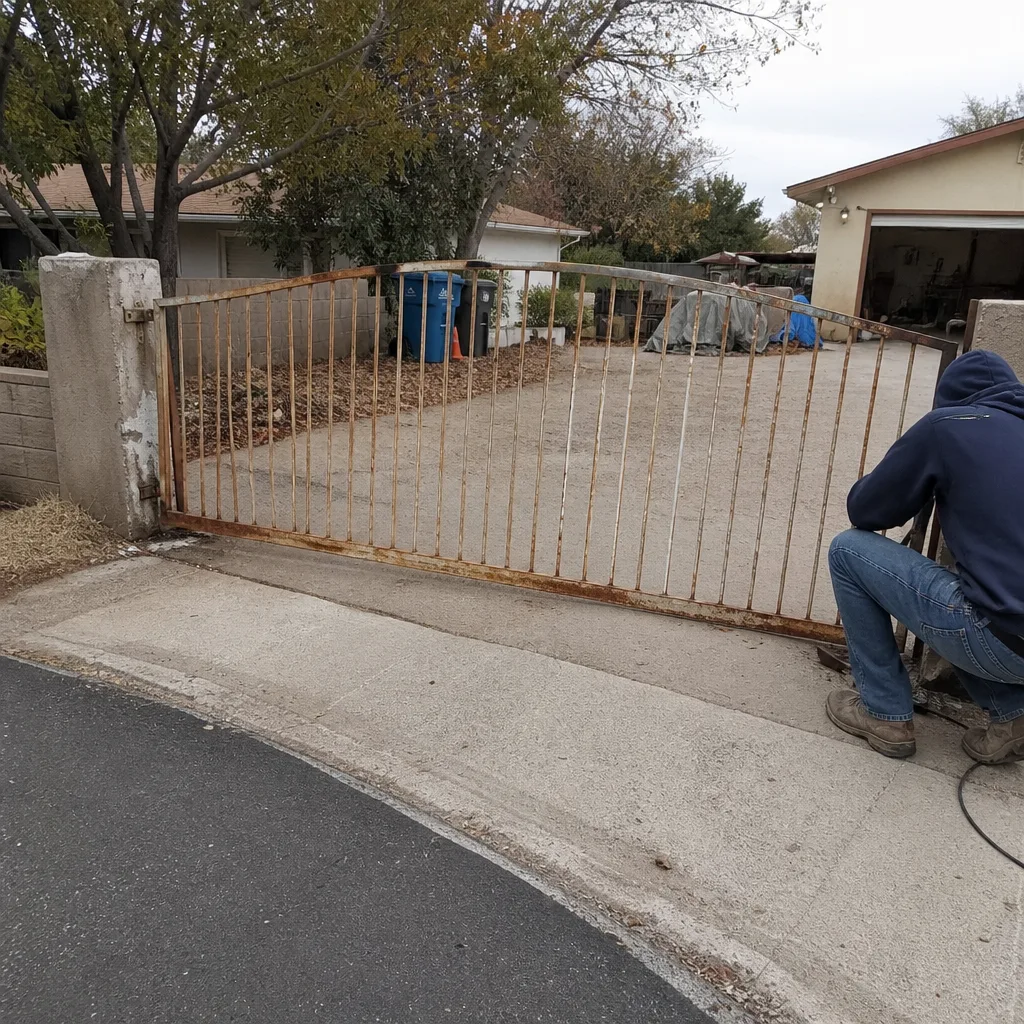 Before
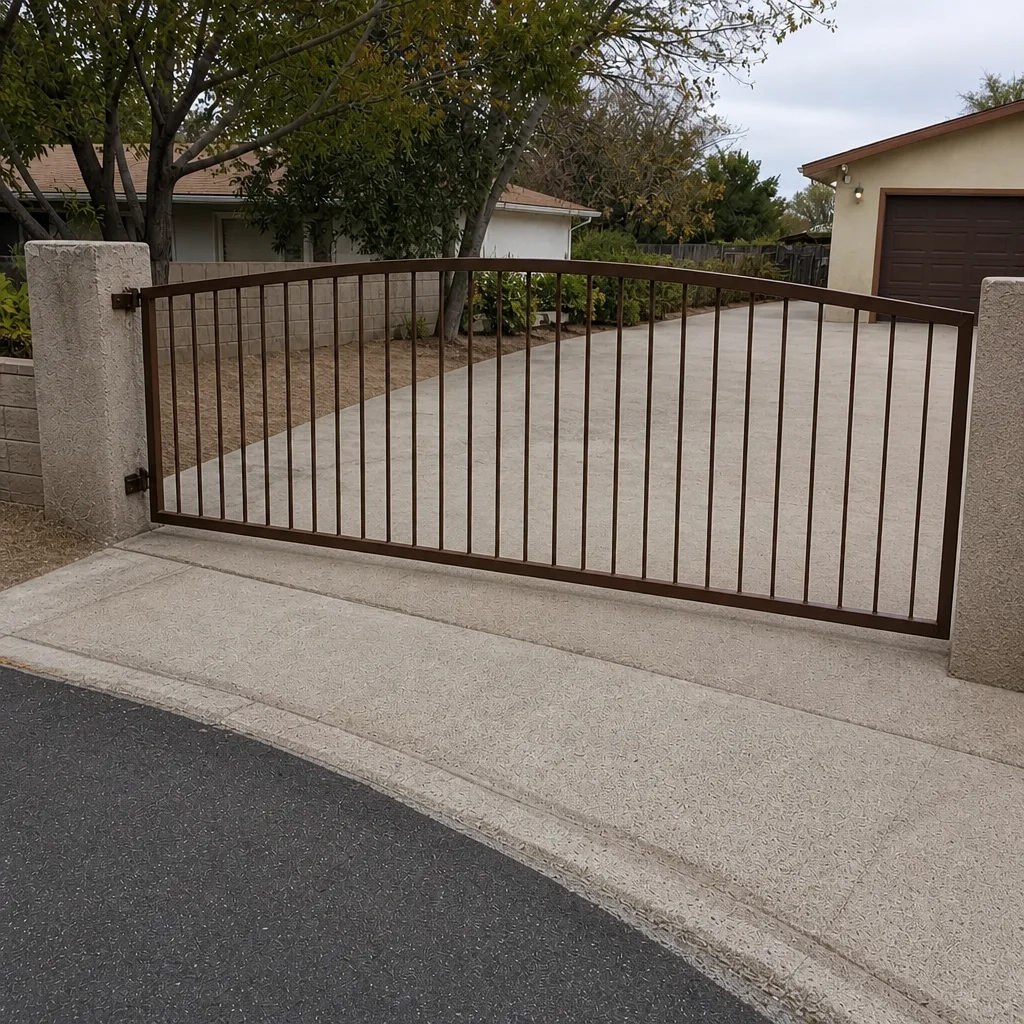 After
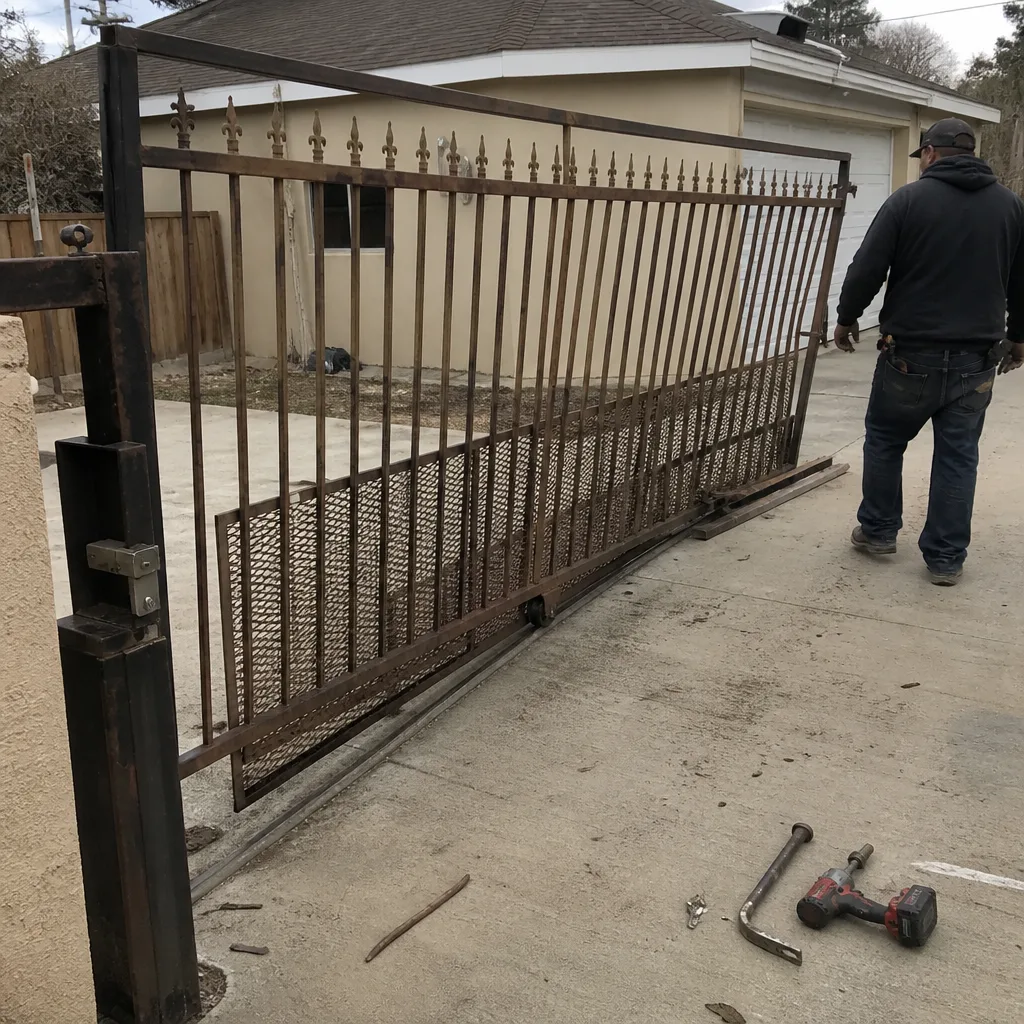 Before
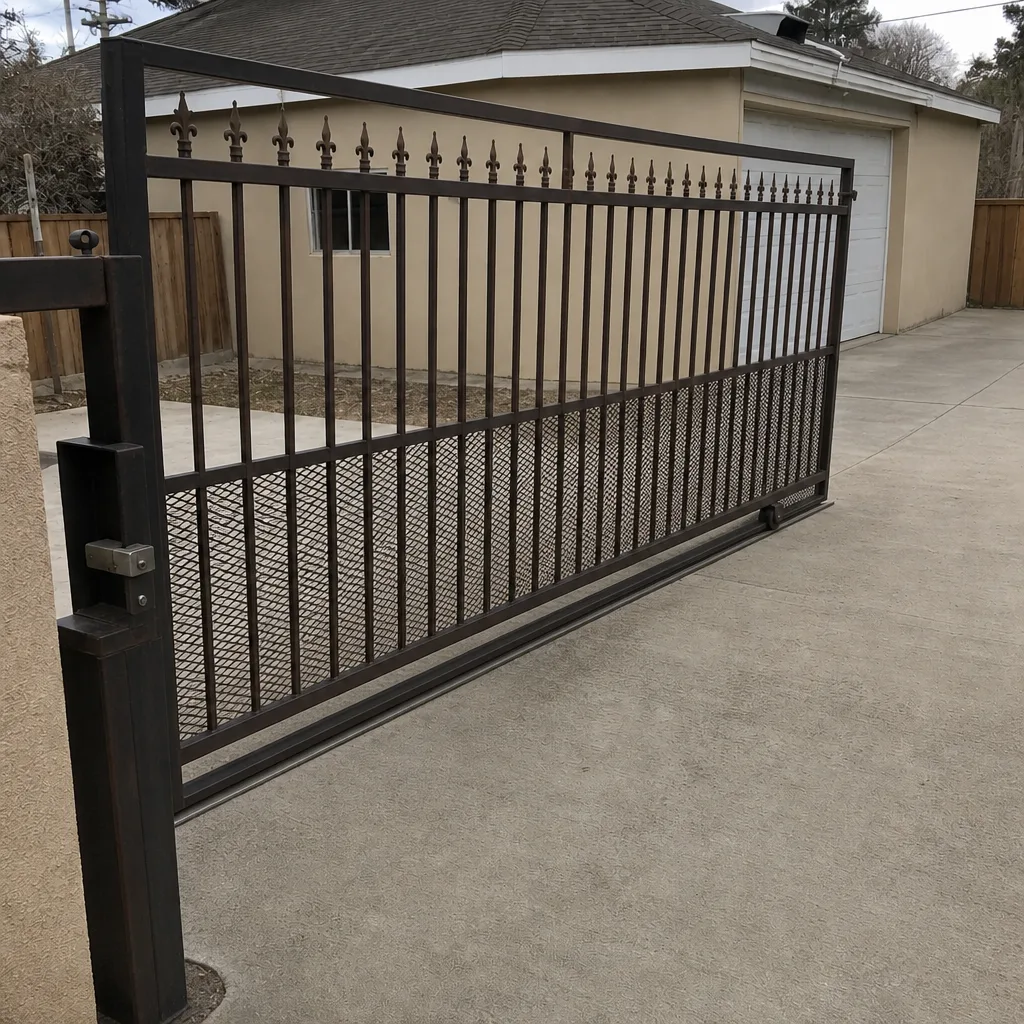 After
When to Call a Professional
Call right away if you see a visible crack at a hinge weld, a bent axle, a post flange separating from the post, or a gate that has dropped or sheared off its track. In those cases, stop operating the gate and keep vehicles and people away until it’s been assessed. Call soon if you notice: bubbling or rust at a weld seam, a growing latch gap, a slow tilt, a hinge that squeals under load, or an operator that binds on its own. For anything short of the immediate signs, an in-person look is what settles it. We put the free second opinion on any written estimate in writing and we show up in the window we promised – the name is on the shop in Paradise, and the shop is down the road. Gatewood Fence & Gate Paradise offers free estimates in Paradise – call (888) 292-7536. Every job carries our 90-Day Done Right Promise in writing, and we answer the phone live, around the clock.
Frequently Asked Questions
A failing hinge produces a high-pitched squeal or grinding sound that gets worse under load and often goes silent in cooler weather. An old hinge that’s just worn will be noisy but consistent, without a crack or bubble at the weld plate. If you see paint bubbling or a hairline crack at the hinge plate, treat it as failing, not aging. Call (888) 292-7536 for a free estimate – we’ll tell you in ten minutes whether it’s a repair or a replacement.
Paint bubbling at a weld seam means rust is lifting from inside a hairline crack in the steel. It is almost always structural, not cosmetic, and it usually starts at a joint that’s been flexing. The right move is to have the seam looked at by someone who can weld, not a painter. Send us a photo and we’ll tell you exactly what we’re seeing.
Put a little weight on the open end of the gate and watch the two connections. If the hinge plate moves on the post, it’s a hinge. If the post itself moves or the ground around the base flexes, it’s a footing problem. Slow tilts over months are essentially always footing, and repairing the hinges without the post means you’ll fix it twice.
About a quarter inch of seasonal movement on a wood-post gate is normal, and even on steel-post gates a small change over the year is expected. Worry when the gap grows and stays grown, when only one side shifts, or when it changes suddenly after a storm or a heavy vehicle. Measure it monthly and call when the change passes a quarter inch on steel.
We weld on site, in your driveway, with the gate still hung. That matters because panels rarely sit correctly after being moved, and a good weld on a twisted gate is wasted work. We cap our mobile welding repair jobs at the same visit whenever the metal and the post allow. Call (888) 292-7536 to schedule.
We work on the major residential and light commercial operators, including DoorKing, Linear, Ghost Controls, Viking, and LiftMaster, and we pair the operator work with the gate repair so both problems get fixed, not one at a time. If your operator keeps quitting on a gate that’s dragging, the operator is the symptom, not the cause. Call (888) 292-7536 for a free second opinion.
The Bottom Line
Your gate is telling you what it needs, and the signs are in the metal long before they show up in behavior. Read the welds, listen to the hinge versus the roller, measure the latch gap, and watch for footing movement over time. Treat a bubbled hinge or a growth in the gap as a scheduled repair. Treat a cracked weld at a primary hinge as a stop. The difference between those two decisions is often the difference between a small repair and a serious injury. Our technicians have up to 25 years of experience reading gates in Paradise and the surrounding counties, and we’re happy to show you what we see – call (888) 292-7536 for a free estimate. We’ll answer the phone, show up when we said, and put the 90-Day Done Right Promise in writing. The Gatewood Fence & Gate Paradise home page has our address and license number if you’d like to look us up first, and the gate motor & opener page covers the operator-side symptoms in more detail.
Written by the team at Gatewood Fence & Gate Paradise.